Authors

Diego Arias
Senior DevOps Engineer
Diego Arias
Senior DevOps Engineer
Leaving VMware means choosing what runs the VMs next. This page scores seven alternatives (Proxmox VE, XCP-ng, OpenStack, Nutanix AHV, Hyper-V, OpenShift Virtualization and Harvester) in six scenarios, then gives each one’s licensing, support terms, backup options and migration path from VMware. The vendor pages behind every line are listed by platform in Sources at the end, all read on 16 November 2026. Nothing here was run, and no cell is a number of mine: each one is Wins, Works or Weak, with the line from the docs behind it.
How a cell is scored:
More than one alternative can win a scenario. Each scenario below gives the reason behind its Wins and Weak cells.
| Small team, tight budget | Data sovereignty | One vendor for servers and storage | A Windows-first team | Edge sites | Already on Kubernetes | |
|---|---|---|---|---|---|---|
| Proxmox VE | Wins | Wins | Works | Works | Works | Weak |
| XCP-ng | Wins | Wins | Works | Works | Works | Works |
| OpenStack | Weak | Wins | Weak | Weak | Weak | Works |
| Nutanix AHV | Weak | Works | Wins | Works | Wins | Works |
| Hyper-V | Works | Works | Works | Wins | Works | Works |
| OpenShift Virtualization | Weak | Works | Works | Works | Works | Wins |
| Harvester | Works | Works | Works | Works | Works | Wins |
Proxmox VE and XCP-ng win: both are free to run with every feature, and both publish their support prices.
XCP-ng, Proxmox VE and OpenStack win: open source, run where you choose, and each one’s vendor or foundation documents the case.
Nutanix AHV wins: the hypervisor, the storage and the management come in one licence.
Hyper-V wins: it is part of Windows Server, which the team already licenses.
Whatever the hypervisor, Windows Server stays licensed per core, with “CALs … required for every user or device accessing a server”.
Nutanix AHV wins: small clusters at every site, managed from one place, under its own licence.
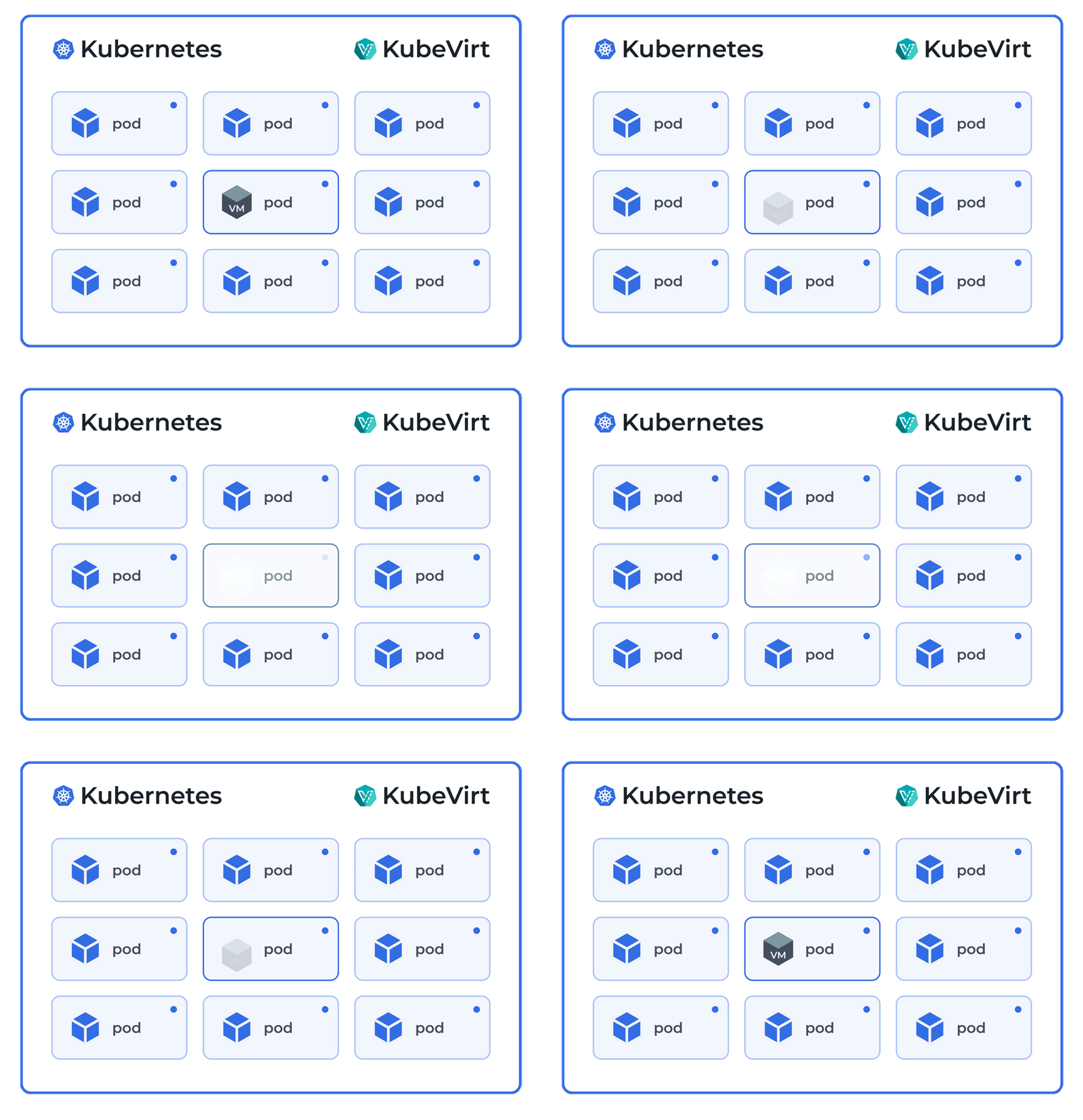
OpenShift Virtualization and Harvester win: both run the VMs on the Kubernetes cluster itself.
Broadcom completed its acquisition of VMware on 22 November 2023. It then stopped selling perpetual licences, so “offerings will solely be available as subscriptions or as term licenses”, with VMware Cloud Foundation and vSphere Foundation as the two offers.
Many import tools read VM disks through VMware’s Virtual Disk Development Kit (VDDK). Broadcom’s wording is that “access to the VDDK SDK is made available only to those who are part of the Technology Alliance Program (TAP)”; its public download pages stopped answering in August 2026, and Red Hat says “VMware VDDK images are currently unavailable to end-users via standard public downloads”. So check each tool before you plan the move:
| Alternative | Official import tool | Needs VDDK? |
|---|---|---|
| Proxmox VE | Import wizard, ESXi 6.5 to 8.0 tested (guide) | The guide does not mention VDDK |
| XCP-ng | Xen Orchestra V2V, ESXi 6.x to 8.x (guide) | No: "nothing to download from VMware or Broadcom" |
| OpenStack | virt-v2v, Coriolis, MigrateKit (guide) | The guide does not say |
| Nutanix AHV | Nutanix Move, free (DirectPath) | Not for eligible configurations, since Move 6.3.3 |
| Hyper-V | Windows Admin Center VM Conversion, preview (guide); SCVMM 2025, offline only | Windows Admin Center: yes, VDDK 8.0.3 only; the SCVMM page does not mention it |
| OpenShift Virtualization | Migration Toolkit for Virtualization (solution 7146995) | Yes for vSAN; Red Hat cannot distribute the image |
| Harvester | vm-import-controller add-on (VM import) | The page does not mention VDDK |
The hypervisor is half of what VMware did; vRA’s self-service on top is the other half. In Kestra, the request is a flow: its typed inputs are what the team fills in, one task creates and powers on the VM on Proxmox VE, and one runs the Ansible playbook that configures it. Both plugins are open source, Apache 2.0. If the hypervisor changes, only the create task changes; the inputs and the Ansible step stay.
No published blueprint does exactly this with open-source tasks only, so the flow below joins two of them, each task copied as published: provision_vm with the vm_name and vm_id inputs from Provision a VM and Register It in NetBox (its NetBox steps, which are Enterprise, left out), and ansible_configure with the vm_address and environment inputs from Provision VMware VMs with Ansible and ServiceNow (its vCenter clone, ServiceNow and Slack steps left out). Written for Kestra 1.3.39 or later.
id: proxmox-vm-self-servicenamespace: company.team
inputs:  - id: vm_name    type: STRING    defaults: app-vm-01  - id: vm_id    type: INT    defaults: 201    description: Unused Proxmox VMID to assign to the new VM.  - id: vm_address    type: STRING    description: "Hostname or IP that Ansible will reach the new VM on."  - id: environment    type: SELECT    values: [ dev, staging, production ]    defaults: staging
tasks:  - id: provision_vm    type: io.kestra.plugin.proxmox.vm.Create    description: Create and power on the VM on Proxmox VE.    host: "{{ secret('PROXMOX_HOST') }}"    node: "{{ secret('PROXMOX_NODE') }}"    username: "{{ secret('PROXMOX_USERNAME') }}"    password: "{{ secret('PROXMOX_PASSWORD') }}"    vmId: "{{ inputs.vm_id }}"    vmName: "{{ inputs.vm_name }}"    cores: 2    memory: 4096    disk: "local-lvm:32"    powerOn: true
- id: ansible_configure type: io.kestra.plugin.ansible.cli.AnsibleCLI inputFiles: inventory.ini: | [app] {{ inputs.vm_name }} ansible_host={{ inputs.vm_address }} ansible_user=ubuntu configure.yml: "{{ read(secret('ANSIBLE_PLAYBOOK')) }}" commands: - ansible-playbook -i inventory.ini configure.yml --extra-vars "env={{ inputs.environment }}" retry: type: constant interval: PT2M maxAttempts: 3osTemplate (“a cloud-init image or ISO on the node’s storage”) or a template. Neither blueprint shows that step.| Licence and price | Support | Backup | Worth knowing | |
|---|---|---|---|---|
| Proxmox VE 9.2 | AGPLv3; a subscription buys the Enterprise Repository | EUR 120 to 1,100 per socket a year; 24/7 tickets on Premium | Proxmox Backup Server 4.2; Veeam is a partner | The load balancer is in technology preview; several clusters on one screen need Proxmox Datacenter Manager |
| XCP-ng 8.3 LTS | Free, “all features are available for free”; Xen Orchestra mostly AGPLv3 | Vates VMS, from 2000 a year for 3 hosts to 1800 per host a year for 24/7 | Built into Xen Orchestra; Veeam since 13.1 | The load balancer and V2V are only in the XO 5 interface for now |
| OpenStack 2026.2 | Apache 2.0 | Through one of 22 commercial distributions | Cinder volume backups, Freezer | A minimal install is already five services |
| Nutanix AHV (NCI 7.6) | Inside NCI, per CPU core; no public price | 24x7, P1 answered in 1 hour or 30 minutes | Native DR down to 0 RPO; Veeam | Flow networking is a separate licence |
| Hyper-V (Windows Server 2025) | Per core with CALs: USD 1,176 Standard, USD 6,771 Datacenter for 16 cores | Per incident, 2-hour first response for Severity A; supported until 2034 | Azure Backup Server; checkpoints are not a backup | Load balancing runs only when a node joins, unless you turn it on |
| OpenShift Virtualization 4.22 | In every self-managed OpenShift edition; no public price | Standard in business hours, or Premium 24x7 | OADP, whole VMs or single files | Live migration needs RWX shared storage |
| Harvester v1.9 | Apache 2.0; subscription with no per-CPU fees, no public price | Standard, or Priority with 24x7 for Severity 1 and 2 | NFS or S3, Longhorn volumes only | Upgrading to v1.9.0 is not recommended yet; v1.8.x maintenance ends 2026-12-29 |
Hardware sizing, prices quoted by a sales team, performance, and any platform outside these seven. Every line above is what the vendor’s own pages said on 16 November 2026; check the linked page before you sign anything.
The main pages behind this post, all read on 16 November 2026.
VMware and Broadcom: Broadcom 8-K, Exhibit 99.1; VMware blog; ShapeBlue
Proxmox VE: Admin guide; Pricing; Migrate to Proxmox VE
XCP-ng and Xen Orchestra: Licenses; Vates pricing; V2V guide
OpenStack: Software; Distributions; VMware to OpenStack guide
Nutanix AHV: AHV; Software options; DirectPath
Hyper-V and Azure Local: Editions comparison; Pricing; Migrate
OpenShift Virtualization: Subscription guide; About, OpenShift 4.22; Solution 7146995
Harvester: Harvester overview; SUSE Virtualization; VM import
Kestra: io.kestra.plugin.proxmox.vm.Create; io.kestra.plugin.ansible.cli.AnsibleCLI; Migrating off vRA and vRO

Stay up to date with the latest features and changes to Kestra