Kestra vs. Tray.ai: Universal Orchestration vs. Enterprise AI Automation

Tray.ai is an enterprise automation platform for connecting SaaS applications and deploying AI agents at scale, with purpose-built tooling for governed AI agent creation. Kestra is a workflow orchestration platform for engineering and data teams that need data pipelines, infrastructure automation, and production workflows running with full version control and the option to self-host.
Two Platforms, Two Definitions of Orchestration

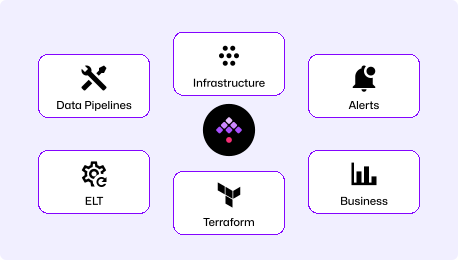
Engineering-Grade Orchestration for Any Workflow

Declarative YAML orchestration platform for engineering and data teams. Define data pipelines, infrastructure automation, and business workflows in version-controlled YAML. Any event, any language, self-hosted or on Kestra Cloud, with GitOps and full audit trails.

"How do I orchestrate data pipelines and infrastructure alongside business workflows, all in version-controlled code?"
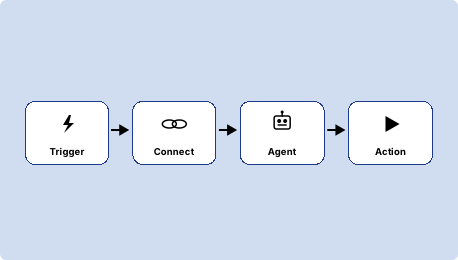
Enterprise iPaaS and AI Agent Platform

Enterprise-grade automation platform built for connecting SaaS applications and deploying AI agents at scale. Visual workflow builder, 700+ pre-built connectors, MCP governance, and built-in compliance controls make it a consolidation platform for enterprise integration and intelligent automation.

"How do I consolidate our enterprise app integrations and deploy AI agents with the governance our security team requires?"

Enterprise Integration Connects Systems.
Orchestration Runs Your Business.

Production-Grade Workflow Orchestration
  • Automate data pipelines, infrastructure, and business processes in one platform
  • Self-hosted or cloud, with full data residency control
  • GitOps-native: version control, CI/CD, and Terraform for all workflows
  • RBAC, audit logs, and multi-tenancy for enterprise compliance
  • Handles 100,000+ concurrent tasks with no per-connector pricing
Enterprise iPaaS and AI Agent Platform
  • 700+ pre-built connectors for enterprise SaaS apps
  • AI agent creation with Merlin Agent Builder and MCP governance
  • SOC 2 Type 2, GDPR, RBAC, and enterprise compliance controls
  • Cloud-only multi-tenant platform (no self-hosting)
  • Quote-based enterprise pricing

Time to First Workflow

Tray.ai is an enterprise SaaS platform accessed via demo request or trial. There is no infrastructure to provision, but onboarding involves account setup, connector authentication, and learning the visual builder. Kestra runs in two commands and is ready in under five minutes.

~5

Minutes
curl -o docker-compose.yml \
https://raw.githubusercontent.com/kestra-io/kestra/develop/docker-compose.yml
docker compose up
# Open localhost:8080
# Pick a Blueprint, run it. Done.

Download the Docker Compose file, spin it up, and you're ready (database and config included). Open the UI, pick a Blueprint, run it. No sales process required, no cloud account, no connector licensing.

~30

Minutes

Request a demo or trial at tray.ai, complete account setup, authenticate your enterprise app connectors via OAuth, and build your first workflow in the visual editor. Enterprise deployments involve procurement, security review, and connector licensing.

Version-Controlled Workflows vs. Visual Enterprise Builder

Kestra: Readable by Your Whole Team

YAML is readable on day 1. Our docs are embedded in the UI for easy reference, the AI Copilot writes workflows for you, or start with our library of Blueprints. Workflows live in Git and deploy through your existing CI/CD pipeline.

Tray.ai: Visual workflows for enterprise integration teams

Tray.ai workflows are built in a visual editor by connecting pre-built connector steps and configuring data mappings. The Merlin Agent Builder extends this to conversational and autonomous AI agents. All configuration lives in Tray.ai's cloud with no local files or version control.

One Platform for Your Entire Technology Stack

Kestra Image

Orchestrate data pipelines, infrastructure provisioning, business processes, and event-driven automations in one platform. Self-host with full control or use Kestra Cloud. Workflows live in Git and deploy like any other code.

Competitor Image

Connect enterprise SaaS apps, deploy AI agents, and manage MCP governance in a unified cloud platform. Strong for enterprise integration consolidation and governed AI agent deployment. Not designed for data pipeline execution, infrastructure automation, or self-hosted deployments.

Kestra vs Tray.ai at a Glance

Primary use case Universal workflow orchestration Enterprise iPaaS and AI agent platform
Workflow definition Declarative YAML (version-controlled) Visual workflow builder (cloud-stored, no local files)
Deployment model Self-hosted or Kestra Cloud Cloud-only (no self-hosting)
Languages supported Agnostic (Python, R, Bash, Node.js, SQL & more) No-code visual builder; custom logic via connector configuration
Data pipeline support
Native support (ETL, dbt, Spark, Airbyte)
Data connectors available but not built for compute-heavy pipelines
Infrastructure automation
Native support
Not designed for this
AI agent support Kestra orchestrates AI workflows and LLM calls via plugins ✓ Merlin Agent Builder with MCP governance
Self-service for non-engineers
Kestra Apps
✓ Visual builder for business and IT teams
GitOps and version control
Native Git sync, Terraform provider
No native version control
Multi-tenancy and RBAC
Enterprise namespace isolation
✓ Enterprise RBAC and compliance controls
Open source
Open source (Apache 2.0)
Closed source SaaS
With Kestra, orchestration stopped being a fragile point in the architecture and became a stable foundation for the business.
Rafael Bartalotti, Engineering Manager @ Víssimo
90%Reduction in integration costs
40%Reduction in BI and ETL costs
0Black Friday 2025 incidents

What Kestra Brings to Engineering and Data Teams

Data pipelines as first-class workflows

1,200+ native plugins cover dbt, Airbyte, Spark, Snowflake, BigQuery, Databricks, and every major data warehouse, cloud provider, and message queue. Data engineers define ETL pipelines in the same declarative YAML they use for event-driven and business workflows, with DAG visualization and retry semantics for data-specific failures as standard. One platform, one operational model, for both data and business automation.

Self-hosted with complete data control

Kestra deploys on Docker or Kubernetes on any infrastructure, including air-gapped environments and on-premises clusters. Workflow definitions, execution logs, and secrets stay on your infrastructure. For teams in regulated industries where data residency is a hard requirement, self-hosted Kestra keeps every piece of execution inside the perimeter you control.

Workflows in Git, deployable like code

Every Kestra flow is a YAML file reviewed in a pull request, versioned in Git, and deployed through the same CI/CD pipeline as your application code. When an automation breaks, git blame and commit history tell you exactly what changed and when. Automation gets the same review, audit, and rollback process as any other production system.

The Right Tool for the Right Job

Choose Kestra When
  • Your team needs data pipelines, ETL, or infrastructure automation alongside business process workflows.
  • Data residency or compliance requires self-hosting, with execution staying on your own infrastructure.
  • Workflows must live in version control, pass code review, and deploy through CI/CD.
  • You want cost to scale with infrastructure, not with connector volume or enterprise licensing.
  • Your engineers own the workflow layer and need observability, retries, and Git history.
Choose Tray.ai When
  • Your primary need is consolidating enterprise SaaS integrations across Salesforce, ServiceNow, Workday, and similar systems.
  • You are deploying AI agents at scale and need built-in MCP governance, guardrails, and identity controls.
  • Business and IT teams need to build and modify automations without engineering ownership.
  • Enterprise compliance and a managed cloud platform matter more than self-hosting flexibility.
  • You want a single platform for integration, AI agents, and API management under centralized governance.

Frequently asked questions

Find answers to your questions right here, and don't hesitate to Contact Us if you couldn't find what you're looking for.

See How

Getting Started with Declarative Orchestration

See how Kestra can simplify your workflows—and scale beyond enterprise iPaaS.