Hi! I'm your Kestra AI assistant. Ask me anything about workflows.
EXAMPLE QUESTIONS
How to add secrets?
How to deploy Kestra inside Kubernetes?
How to run Python script?
/
Kestra vs. Pipedream: Orchestration vs. Integration
Pipedream is a cloud-based integration platform built around event triggers and serverless code steps. Kestra is a workflow orchestration platform for teams that need data pipelines, infrastructure automation, and business processes running at production scale—self-hosted or in the cloud.
Declarative YAML orchestration platform built for engineering teams. Run data pipelines, infrastructure automation, and business workflows at scale, in any language, self-hosted or on Kestra Cloud, with GitOps and full audit trails.
"How do I build reliable, scalable workflows my whole team can operate?"
API Integration and Event-Driven Automation
Serverless integration platform for connecting APIs and services. Define workflows as JavaScript or Python steps, triggered by webhooks, schedules, or app events. Best for lightweight automation and API glue between SaaS tools.
"How do I connect these APIs and automate this event quickly?"
Integration Connects Apps. Orchestration Runs Your Business.
Production-Grade Workflow Orchestration
Automate data pipelines, infrastructure, and business processes in one platform
Self-hosted or cloud, with full data residency control
GitOps-native version control, CI/CD, and Terraform for all workflows
RBAC, audit logs, and multi-tenancy for enterprise compliance
Handles 100,000+ concurrent tasks without per-execution billing
Pipedream
API Integration and Automation
Connects 2,700+ pre-built app integrations
Serverless execution in JavaScript or Python
Cloud-only, fully managed infrastructure
Free tier limited to 3 workflows and 100 credits per day
Acquired by Workday in 2024
For teams connecting SaaS apps and routing webhooks without managing infrastructure, Pipedream covers the basics. When you need production data pipelines, self-hosting for compliance, or workflows that span data, infrastructure, and operations, Kestra is built for that scope.
Time to First Workflow
Pipedream is a cloud-only platform—there is no self-hosted or local install option. This comparison uses their cloud onboarding path: sign up, connect apps via OAuth, and write workflow steps in the browser.
Download the Docker Compose file, spin it up, and you're ready—database and config included. Open the UI, pick a Blueprint, run it. No cloud account required, no vendor lock-in.
Pipedream
~15
Minutes
# Sign up at pipedream.com
# Connect your first app via OAuth
# Write step logic inJavaScript:
exportdefaultdefineComponent({
asyncrun({ steps, $ }) {
return { status: "connected" }
}
})
Sign up at pipedream.com, connect your apps via OAuth, and write workflow steps in JavaScript or Python. No infrastructure to manage, but all workflows run on Pipedream's cloud only.
YAML is readable on day 1. Our docs are embedded in the UI for easy reference, the AI Copilot writes workflows for you, or start with our library of Blueprints. No special training required.
Pipedream
Pipedream: JavaScript steps for every action
// Trigger: Daily schedule (0 8 * * *)
// Step 1: Run dbt (custom code step)
exportdefaultdefineComponent({
asyncrun({ steps, $ }) {
const { execSync } =require("child_process");
execSync("dbt run --select reporting");
return { status: "dbt complete" };
}
});
// Step 2: Slack notification
// Uses Pipedream's pre-built Slack action
// Configured via UI with message: "Daily report ready"
Each workflow step is a JavaScript or Python function. Pre-built app actions reduce boilerplate for common integrations, but complex logic requires writing and deploying code to Pipedream's cloud.
One Platform for Your Entire Technology Stack
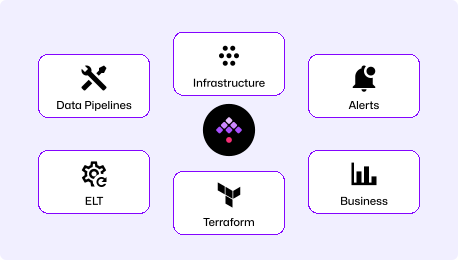
Orchestrate data pipelines, infrastructure provisioning, business processes, and customer workflows in one platform. Self-host with full control or use Kestra Cloud.
Pipedream
Connect SaaS apps and automate event-driven integrations in the cloud. Excellent for webhook routing and API glue, but not designed for heavy data pipelines or self-hosted deployments.
Kestra vs Pipedream at a Glance
Pipedream
Primary use case
Universal workflow orchestration
API integration and event-driven automation
Workflow definition
Declarative YAML
JavaScript or Python code steps
Deployment model
Self-hosted or Kestra Cloud
Cloud-only (no self-hosting)
Languages supported
Agnostic (Python, R, Bash, Node.js, SQL & more)
JavaScript, Python, Bash, Go (within steps)
Data pipeline support
Native support (ETL, dbt, Spark, Airbyte)
Not designed for heavy data workloads
Infrastructure automation
Native support
Not designed for this
Self-service for non-engineers
Kestra Apps
Visual builder for simple automations
GitOps and CI/CD
Native Git sync, Terraform provider
Basic version history
Multi-tenancy and RBAC
Enterprise namespace isolation
Team features on paid plans only
Open source
Open source (Apache 2.0)
Closed source
We looked at Airflow and NiFi, but Kestra's architecture made the most sense for us in terms of scalability. The wide range of plugins and the ability to integrate with our systems was a key factor in our decision.
Run Kestra on your own infrastructure (Docker, Kubernetes, air-gapped) or use Kestra Cloud. You own the data, the deployment, and the cost model. No vendor lock-in from a SaaS acquisition.
Orchestrate data, infrastructure, and operations
Kestra is not limited to connecting SaaS apps. Run dbt models, Spark jobs, Terraform plans, and custom scripts in isolated containers, all from declarative YAML with no wrappers or decorators required.
Built for engineering teams at scale
GitOps sync, Terraform provider, RBAC, and audit logs make Kestra deployable like real infrastructure. Teams version control, review, and ship workflows with the same rigor as application code.
The Right Tool for the Right Job
Choose Kestra When
You need production data pipelines, ETL, or data warehouse orchestration, not just API connections.
Your team needs self-hosting for compliance, data residency, or cost predictability.
Workflows span multiple layers: data pipelines, infrastructure provisioning, and business processes.
You want GitOps, Terraform, and CI/CD for workflow deployment like any other infrastructure.
Non-engineers need to trigger and monitor workflows without writing code.
Pipedream
Choose Pipedream When
Your primary need is connecting SaaS apps and routing webhooks quickly.
You want a fully managed cloud service with no infrastructure responsibility.
Workflows are lightweight: event-driven, short-running, and API-focused.
Your team prefers writing JavaScript or Python over YAML configuration.
You are prototyping integrations and do not need data pipeline or infrastructure automation.
Frequently asked questions
Find answers to your questions right here, and don't hesitate to Contact Us if you couldn't find what you're looking for.
Extract the business logic from your Pipedream JavaScript steps and run it directly as Script tasks in Kestra. Python and Shell scripts work as-is in isolated containers. Replace Pipedream's pre-built app actions with Kestra's plugin library, which covers Slack, HTTP, databases, cloud storage, and more. Define triggers (schedules, webhooks, file arrivals) in YAML, and you have the same workflow running with full version control and your choice of deployment target.
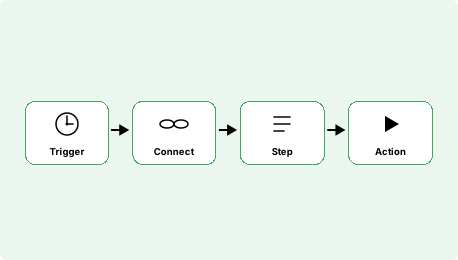
Yes. Kestra has native webhook triggers that start workflows on HTTP events, plus event-driven triggers for Kafka, S3, database changes, and API polling. You can build the same webhook-to-action automations Pipedream is known for, with the added ability to chain those events into complex multi-step pipelines involving data transformation, infrastructure changes, or cross-team notifications.
Kestra's 1,200+ plugins cover the most common integration targets: AWS, GCP, Azure, Slack, databases, data warehouses, dbt, Airbyte, and more. For apps not covered by a plugin, the HTTP plugin handles REST API calls to any endpoint, and Script tasks run arbitrary code in any language. Pipedream's pre-built actions reduce setup time for simple integrations. Kestra's approach gives you more control for workflows that go beyond API glue.
Pipedream was acquired by Workday in 2024. Platform acquisitions often bring pricing changes or product deprecations that don't fit the acquirer's roadmap. If you are building critical automation on Pipedream, start evaluating migration before that decision is made for you. Kestra's Apache 2.0 license means you can fork it, host it, and keep running it regardless of who owns Pipedream next year.
Kestra takes about 5 minutes to run locally with Docker. Pipedream requires no infrastructure but binds you to their cloud. Kestra gives you self-hosting, Git sync, and full workflow portability. Pipedream gives you a faster start with managed infrastructure but no option to move off their platform. For teams that need GitOps, Terraform integration, and the ability to self-host, that's a straightforward trade.
Yes. Kestra Apps let non-technical users trigger, monitor, and interact with workflows through a no-code interface without writing YAML or accessing the engineering UI. Kestra also has a visual flow editor that updates the DAG in real time as you type. RBAC and namespace isolation keep engineering and business-user workflows from stepping on each other.
Getting Started with Declarative Orchestration
See how Kestra can simplify your workflows—and scale beyond API integration.