Authors

François Delbrayelle
Lead Software Engineer
François Delbrayelle
Lead Software Engineer
The Plugins & Ecosystem Squad maintains more than 200 plugin, storage, and secret repositories. A single day can mean spinning up a local Kestra stack, building a shadow JAR, checking which repos have unpushed work, merging a wave of Dependabot PRs, and cutting a few releases. None of it is hard. All of it is repetitive, and every repetition is a chance to forget a flag, point Vite at the wrong port, or release a version that was already tagged.
We had a second, quieter problem too. Once we started routing plugin work through AI agents (see our earlier post on automating the plugin SDLC), the agents hit the exact same friction. Ask an agent to “deploy plugin-mqtt locally and restart Kestra” and it will happily reconstruct the Gradle task, the JAR-finding logic, the copy-into-plugins step, and the restart, from scratch, every time. That is slow, it is error-prone, and it costs a surprising number of tokens to re-derive something we already know how to do.
Plugin Devtools is our answer to both. It is an internal repository of standalone shell scripts, one per recurring task, each runnable directly from the terminal. Three goals shaped it:
kestra-plugin-shadowjar plugin-mqtt --restart-kestra rather than improvising the whole flow.That last point is the one people underestimate. A script is a contract. The agent does not need to know how a release avoids duplicate tags or shuts down the daemons it leaks; it needs to know the command exists and what it does. The messy knowledge lives in the script, versioned once, instead of being re-explained in every agent context.
kestra-core-run starts the full dev stack (backend, frontend, Postgres, and the ui-libs watcher) from local source, health-checks both services, and prints the URLs. It also runs EE, runs either edition from a Docker image, checks out branches before starting, tails logs, and stops instances gracefully or hard.
❌ By hand, every time:
cd ~/dev/kestradocker start kestra-postgres-1# is port 8080 free? does Vite still proxy to :8080, frontend on :5173?cd ui && npm install && npm run dev &./gradlew :cli:runLocalPostgres --init-script ... --no-daemon &# now wait, and guess when it is actually ready✅ With the script:
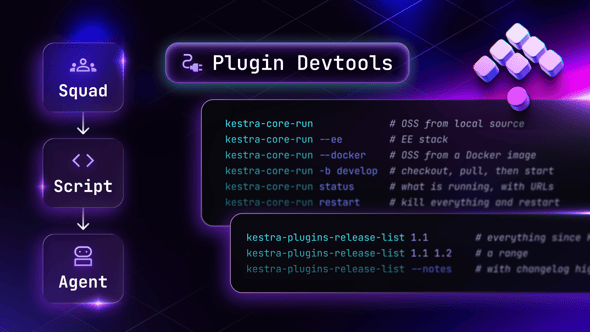
kestra-core-run # OSS from local sourcekestra-core-run --ee # EE stackkestra-core-run --docker # OSS from a Docker image (ephemeral H2)kestra-core-run -b develop # checkout, pull, then startkestra-core-run status # what is running, with URLskestra-core-run restart # kill everything and restartOnce it is up (or on kestra-core-run status), it prints an actionable summary right away:
Kestra OSS [v0.24.0-12-ga1b2c3d4e5 · feat/my-feature a1b2c3d4e5] UI → http://oss.kestra.repo.localhost:1355/ui/ Dev → http://localhost:5176/ API → http://localhost:8080/api/v1/ DB → postgres://localhost:5432/kestra_oss_feat_my_feature Auth → admin@example.com / dev-password Logs → /tmp/kestra-backend.log /tmp/kestra-frontend.log Boot → 47sDocker instances can run side by side on separate ports, so two versions can be compared at once. When a Gradle build fails, the script prints the actual compiler error: lines inline instead of leaving the log to grep through by hand. Small thing, saves a minute every time.
Once plugin source is edited, kestra-plugin-shadowjar builds the shadow JAR and deploys it into the local plugins directory under Kestra’s artifact naming convention. Multi-module plugins produce one JAR per submodule, and the script handles all of them, cleans out stale versions, and can restart Kestra afterward.
❌ By hand:
cd ~/dev/plugin-kafka && ./gradlew shadowJar# find the right jar in build/libs (not -sources, not -javadoc)rm ~/dev/plugins/plugin-kafka-*.jarcp build/libs/plugin-kafka-1.x.y-SNAPSHOT.jar ~/dev/plugins/# then restart Kestra so it picks the jar up✅ With the script:
kestra-plugin-shadowjar # fuzzy-select which plugins to buildkestra-plugin-shadowjar plugin-mqtt plugin-kafka # non-interactive, agent-friendlykestra-plugin-shadowjar plugin-mqtt --restart-kestraThe two together are the tight edit-build-see loop: change code, kestra-plugin-shadowjar plugin-x --restart-kestra, refresh the browser.
Working against one repo is easy. Working against the whole org is where the scripts earn their keep.
kestra-plugins-repositories-clone-missing fetches the current list of plugin-*, storage-*, and secret-* repos from GitHub and clones whatever is missing locally, skipping archived and template repos. Run it from the dev directory whenever the org has grown.
# ❌ By hand: open github.com/kestra-io, scroll 200+ repos,#    work out which ones are missing, clone them one at a time.
# ✅ With the script:cd ~/dev && kestra-plugins-repositories-clone-missing
kestra-plugins-status surveys local git state across every clone and groups the results: uncommitted changes, repos left on a feature branch, unpushed commits, repos behind origin/main. It is read-only unless asked to fetch first, and it answers “what is the state of the clones right now?” in about a second instead of 50 manual git status calls. Handy before a release session or after a week away.
# ❌ By hand: cd into each repo, git status, git log @{u}.., repeat 200+ times.
# ✅ With the script:kestra-plugins-status
kestra-plugins-pull switches each repo to main and runs git pull --ff-only, skipping any repo with local changes so uncommitted work is never touched.
# ❌ By hand:# cd ~/dev/plugin-aws  && git switch main && git pull# cd ~/dev/plugin-gcp  && git switch main && git pull# ... repeat 200 times
# ✅ With the script:kestra-plugins-pull
kestra-plugins-search runs a ripgrep search across every clone in parallel and groups matches by repo, respecting .gitignore and defaulting to Java files. Finding every implementer of an interface across the fleet becomes one command instead of hand-assembling the path globs and flags each time:
# ❌ By hand:rg -n "RunnableTask" ~/dev/plugin-*/ ~/dev/storage-*/ ~/dev/secret-*/
# ✅ With the script (parallel, grouped by repo, prompts for file type):kestra-plugins-search "RunnableTask"
kestra-plugin-scaffold is the heaviest of the fleet tools. Bootstrapping a new plugin by hand means clicking “Use this template” on GitHub, cloning, running sed across a dozen files, moving package directories, deleting the example task, committing, and pushing. The script does all of it in one pass: it creates the repo from kestra-io/plugin-template if it does not exist, rewrites every placeholder to match the new name and OSS or EE conventions, deletes the scaffold classes, makes one clean commit, and asks before pushing. It knows the package and Gradle group conventions for each repo type, so plugin-ee-*, storage-*, and secret-* all land in the right namespace.
# ❌ By hand: Use this template on GitHub, name the repo, clone it,#    sed across a dozen files, move two package dirs, delete Example.java,#    edit devcontainer.json, commit, push.
# ✅ With the script (one command, one clean first commit):kestra-plugin-scaffold
kestra-agents-update keeps our AI tooling consistent. It symlinks each repo’s .claude and .opencode directories back to our central engineering-ai-hub, so a single change to an agent or skill propagates to every plugin repo at once.
# ❌ By hand: ln -s in every repo, recompute relative paths,#    handle .git/info/exclude, redo it whenever the hub changes.
# ✅ With the script (wire up every plugin repo):kestra-agents-update pluginskestra-plugin-release is the most careful script in the repo, because releasing is where mistakes are expensive. It scans every plugin for unreleased commits in parallel (cached for 30 minutes), shows a badge next to each, and offers four modes: standard (pick a bump per plugin), batch (one bump for all), auto (bump inferred from conventional commit messages), and hotfix (cherry-pick onto an existing tag). It suggests the version bump from the commit history, checks whether a tag already exists before releasing, and derives the version from the last released tag rather than a possibly-stale local file.
It also carries a good deal of hard-won operational knowledge, like shutting down the Gradle daemons a release spawns so a batch run does not saturate RAM. That is exactly the kind of thing nobody wants an agent (or a human) rediscovering under pressure.
# ❌ By hand, per plugin: check unreleased commits, pick a bump, verify#    the tag isn't already taken, git switch main, fast-forward,#    ./gradlew release..., then clean up the leaked Gradle daemons.
# ✅ With the script:kestra-plugin-release
kestra-plugins-release-list audits which plugins shipped a release since, or between, chosen Kestra core versions, marks brand-new plugins, and can pull the feat/fix lines from each release body.
❌ By hand this means opening each plugin repo’s releases tab and eyeballing anything newer than the Kestra release date.
# ✅ With the script:kestra-plugins-release-list 1.1 # everything since Kestra 1.1.0kestra-plugins-release-list 1.1 1.2 # a rangekestra-plugins-release-list --notes # with changelog highlightsTwo dashboards cover incoming work. kestra-plugins-issues searches open issues org-wide and loads them into a filterable table (by status, assignee, kind/* label, or release), then opens the picked one in the browser. kestra-plugins-prs does the same for pull requests, showing CI status, review state, and age in one table, sorted so failing CI and changes-requested reviews float to the top.
# ❌ By hand: open each repo's Issues (or Pull requests) tab, juggle#    the same search filters, scroll, repeat across 200+ repos.
# ✅ With the scripts:kestra-plugins-issueskestra-plugins-prs
kestra-plugins-merge-dependabot-prs is the one that saves the most wall-clock time. It walks every repo, checks CI on each open Dependabot PR, and acts: approve and squash-merge the green ones, post @dependabot rebase on conflicts, and, for the common case of a red Gradle-wrapper bump caused by line endings, renormalize and push the fix so CI can go green. A --dry-run flag previews the whole plan before anything happens.
# ❌ By hand: open 200+ repos, find each Dependabot PR, check CI,#    approve, merge (or fix the red one)... dozens of times.
# ✅ With the script:kestra-plugins-merge-dependabot-prs --dry-run # previewkestra-plugins-merge-dependabot-prs # merge everything greenTwo scripts answer a question we kept asking informally: how complete are our clients against the live API? They derive the 100% from the actual Micronaut controllers in the OSS and EE backends at a given ref, not from an OpenAPI spec, then match what each client implements.
kestra-sdk-api-coverage reports coverage for the hand-written Python, Go, and Java SDKs and lists the biggest gaps by resource. kestra-kestractl-api-coverage does the same for the kestractl CLI, resolving CLI calls through the generated Go SDK, and surfaces “quick wins”: endpoints the SDK already exposes that the CLI has not wrapped yet. Both write a JSON report with --json for anything downstream that wants to consume the numbers.
# ❌ By hand: read every backend controller, list its routes, grep each#    SDK (or trace each CLI command through the Go SDK) for matches.#    No real number at the end, just a guess.
# ✅ With the scripts:kestra-sdk-api-coveragekestra-kestractl-api-coveragekestra-recap fetches everything touched across the kestra-io org on the last working day (yesterday, or the previous Friday on a Monday), groups it by repo, collapses cross-repo work into a single line, and prints a Slack-ready standup block. Paste it, fill in the “Today” section, done.
# ❌ By hand: filter GitHub by username, copy PR titles and URLs#    one by one, format the Slack message from memory.
# ✅ With the script:kestra-recap
kestra-laptop-setup is the newcomer’s first command. It is a guided, idempotent installer for a full Kestra dev machine on Ubuntu or macOS: shell, JDKs, Node, Go, Docker, the cloud CLIs, IDEs, SSH keys, and the plugin clones. Every section detects what is already present and skips it, so re-running it to add one tool is safe.
# ❌ By hand: remember 15+ tools, each install method, each config#    location, and every macOS vs Ubuntu difference, in the right order.
# ✅ With the script:kestra-laptop-setupThe pattern that keeps paying off is that a script is a shared contract between a human and an agent. When we teach the squad a new command, the agents get it for free, because the same binary is on the same PATH and the Bash tool calls it the same way. When we fix a sharp edge once (the daemon leak, the duplicate-tag check), the fix lives in one versioned place, and neither a teammate nor an agent has to relearn it.
We did not set out to build an agent framework. We set out to stop typing the same fifteen commands, and it turned out the scripts that made us faster made the agents faster too, for the same reason: the knowledge is written down once, and running it costs almost nothing.

Stay up to date with the latest features and changes to Kestra