Authors

Jérémy Maire
Plugins and Ecosystem Engineer
Jérémy Maire
Plugins and Ecosystem Engineer
For most of Kestra’s life, “cloud plugin” meant one of three things: plugin-gcp, which landed in January 2020, plugin-aws five months later, and plugin-azure in 2022. Nothing else followed for four years.
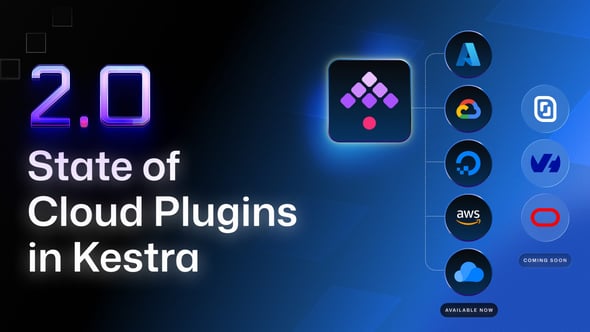
Since March the catalog has picked up Cloudflare, Huawei Cloud, Clever Cloud, and DigitalOcean, more new cloud providers in six months than in the previous six years combined. The work ran in parallel with the 2.0 cycle, so the catalog described here is the one 2.0 ships with. Two things drove it. Our user base stopped being predominantly American, and sovereignty requirements became a hard constraint on where workloads can run instead of a procurement checkbox.
This post is a status report: what ships today, how deep each plugin goes, and where the gaps still are.
A cloud plugin in Kestra can hook into four separate layers of the orchestrator. How many of those it covers says more about its maturity than its task count does.
| Layer | What it does | Example |
|---|---|---|
| Tasks and triggers | Call the provider’s services from inside a flow | io.kestra.plugin.gcp.bigquery.Query |
| Task runner (EE) | Run your script on the provider’s compute | AWS Batch, Azure Batch, Cloud Run, Huawei CCI |
| Internal storage | Kestra’s own object store lives on the provider | storage-s3, storage-gcs, storage-obs |
| Secret manager (EE) | Kestra reads secrets from the provider’s vault | AWS Secrets Manager, Azure Key Vault |
The first layer is the obvious one. The other three make Kestra run natively on the provider instead of calling its APIs from the outside. Task runners reverse the direction of the relationship: your flow stops reaching out to the cloud, and the cloud runs your workload and reports back.
Each section below answers the same question for one provider: how far up that stack it goes.
Google Cloud, AWS, and Azure are the only providers covering all four layers, and the numbers reflect it.
| Plugin | Tasks | Triggers | Task runners (EE) | Storage | Secrets (EE) |
|---|---|---|---|---|---|
plugin-gcp | 74 | 8 | 3 | GCS | Google Secret Manager |
plugin-aws | 61 | 8 | 2 | S3 | AWS Secrets Manager |
plugin-azure | 71 | 11 | 2 | Blob Storage | Azure Key Vault |
The task runners deserve a closer look, because each provider converged on the same pair: one container-based runner, and one that runs directly on a machine.
On AWS that is Batch (backed by ECS on Fargate or EC2, or by EKS) and Ec2, which launches an instance and drives it through Systems Manager Run Command. Commands run natively on the instance, with no container and no inbound SSH, which is the only way to run commercial software whose license binds to a specific AMI (Amazon Machine Image) or instance identity. Azure mirrors the pair with Batch and VirtualMachine, the latter going through the Azure Run Command API, so the VM needs no public IP and no inbound rules at all.
Google Cloud gets three, because Google has three plausible answers to “where should this container run”: Batch, CloudRun, and ComputeEngine.
The Cloud Run runner has the most instructive detail in the catalog. Cloud Run logs come back through Cloud Logging, whose read API is capped at 60 requests per minute per project, and Google does not raise that quota. In practice you get a handful of concurrent Cloud Run tasks before log lines, and therefore task outputs, start going missing without any error to explain it. So the runner gained a useBucketForLog option that writes stdout and stderr into the staging GCS bucket instead, since Cloud Storage meters reads per bucket, not per project. That option exists because someone hit the quota in production, and that is where most of the detail in these plugins comes from.
plugin-huawei shipped in June and is by some distance the most complete newcomer: 37 tasks, 8 triggers, an EE counterpart with a task runner and a log exporter, and storage-obs as an internal storage backend, which is three of the four layers inside three months.
It was deliberately built as a service-by-service mirror of the AWS plugin, and almost every task names its AWS counterpart in its own documentation.
| Huawei service | Kestra tasks | AWS equivalent |
|---|---|---|
| OBS | Upload, Download, List, Copy, DeleteList | S3 |
| DIS | PutRecords, Consume, RealtimeTrigger | Kinesis |
| DLI | Query | Athena |
| FunctionGraph | Invoke | Lambda |
| SMN | Publish | SNS |
| EventGrid | PutEvents | EventBridge |
| MRS | CreateClusterAndSubmitJob, SubmitJob | EMR |
| SWR | GetAuthToken | ECR |
| RFS | Create, Delete | CloudFormation |
| GeminiDB | GetItem, PutItem, Query, Scan | DynamoDB |
If you already run AWS flows, porting them is mostly swapping type: lines. The S3 upload below becomes an OBS upload by changing the type, the region, and the name of one credential property; from, bucket, and key stay as they were.
id: upload_exportnamespace: company.team
inputs:  - id: export    type: FILE
tasks:  - id: to_s3    type: io.kestra.plugin.aws.s3.Upload    region: eu-west-1    accessKeyId: "{{ secret('AWS_ACCESS_KEY_ID') }}"    secretKeyId: "{{ secret('AWS_SECRET_KEY_ID') }}"    from: "{{ inputs.export }}"    bucket: exports    key: daily/export.csv
- id: to_obs type: io.kestra.plugin.huawei.obs.Upload region: eu-west-101 accessKeyId: "{{ secret('HUAWEI_AK') }}" secretAccessKey: "{{ secret('HUAWEI_SK') }}" from: "{{ inputs.export }}" bucket: exports key: daily/export.csvFor anything without a dedicated task there is koocli.KooCLI, which runs hcloud commands in a container with credentials injected from the plugin’s connection properties, including on the EU sovereign region eu-west-101.
plugin-digitalocean arrived in August with 39 tasks, following the DigitalOcean partnership. Coverage tracks what people actually run there: droplet, volume, database, kubernetes, loadbalancer, firewall, and domain.
It is a provisioning and lifecycle plugin more than a data plugin. Plenty of teams spin droplets up and down on a schedule and would rather do it next to everything else they orchestrate.
plugin-cloudflare does not follow the IaaS pattern of the others: 29 tasks across zones, dns, cache, waf, workers, d1, compute, and models.
Purging a cache, updating a WAF rule, querying D1, deploying a Worker: these are edge operations, and in practice they show up as the last step of a deployment pipeline. The models package, which covers Workers AI, is the one to watch, because it puts inference at the edge inside a flow.
We get asked about European hosting more than about any other topic in this area. What ships today is plugin-clevercloud, released in July: 29 tasks and 4 triggers against the French PaaS. The plugin’s shape follows the platform’s shape, so instead of buckets and queues you get applications (create, scale, redeploy, restart, stop, environment variables), addons (provision a managed database, link it to an app, read back its connection credentials), deployments (including a WaitForState that polls until a deploy lands on OK, FAIL, or CANCELLED), logs (fetch a historical window, stream live, manage drains), and organisations for membership.
The triggers are what make the plugin useful for operations. deployments.Trigger fires when a deploy reaches a target state and deliberately ignores UNDEPLOY records, so scaling events do not masquerade as releases. logs.LogPatternTrigger fires on a regex match in application logs and returns every matching line from that poll rather than only the first, which matters when an incident produces a burst rather than a single line. Between them you can run a deploy-and-verify loop on a European platform without your telemetry leaving it.
Three cloud providers are tracked as open issues today, and two of them are European.
kestra-io/plugin-scaleway#2 is planned to cover Object Storage (S3-compatible), Compute Instances, Serverless Functions and Containers, Managed Databases, VPC and networking, Queues and Topics (SQS and SNS-compatible), Kubernetes Kapsule, and Generative APIs.
kestra-io/plugin-ovhcloud#2 covers OVHcloud compute: Public Cloud instances, bare metal servers, and Managed Kubernetes.
kestra-io/plugin-oci#2 scopes a full Oracle Cloud Infrastructure suite. OCI comes up most often from teams already running Oracle databases who want the surrounding infrastructure orchestrated from the same place.
If your provider is on none of those lists, the fastest way to change that is to open an issue on GitHub or tell us on Slack.
Every plugin mentioned here is browsable on the Plugins page under the CLOUD category, with the full task list and property reference for each.
If you like the project, give us a GitHub star and join the community.

Stay up to date with the latest features and changes to Kestra