/

Kestra vs. Astronomer: Orchestrate Beyond Python Pipelines

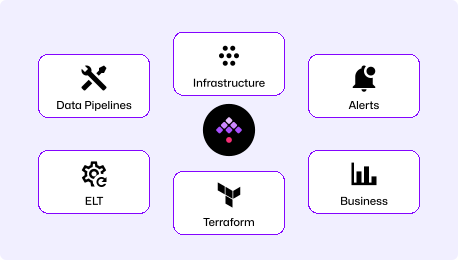
Astronomer makes Airflow easier to run. Kestra makes orchestration easier to use. Astro removes the infrastructure burden of Apache Airflow. Kestra removes the Python-only constraint entirely, and extends orchestration beyond data pipelines to infrastructure, business processes, and AI workflows.
kestra ui

Two Approaches to Managed Orchestration

Universal Orchestration: Any Language, Any Workflow

Declarative YAML orchestration layer that runs workflows in any language without wrapping your code in framework-specific abstractions. Data pipelines, infrastructure automation, and business processes run from one control plane. The workflow definition is configuration, not code.

"How do we orchestrate data, infrastructure, and business workflows without locking our team into Python?"
Managed Apache Airflow

A fully managed SaaS platform built on top of Apache Airflow. Astro removes the operational overhead of running Airflow yourself: no infrastructure to manage, enterprise RBAC and SSO included, cloud-native scaling. Workflows are still Python DAGs, and the Python-first constraint comes with them.

"How do we run Airflow at scale without managing the infrastructure ourselves?"

Managed Airflow vs. Universal Workflow Orchestration

Universal Workflows
  • Data pipelines, infrastructure automation, business processes, AI workflows
  • Multi-language: Python, SQL, Bash, Go, Node.js, R
  • Event-driven at core: respond to real events, not just schedules
  • Self-service for non-engineers via Kestra Apps
  • Open source core with no SaaS dependency
Managed Data Pipelines
  • Apache Airflow, fully managed on Astronomer's cloud
  • Python DAGs: the Airflow mental model, managed for you
  • Data engineering scope
  • Enterprise RBAC, SSO, SOC2, HIPAA
  • Premium SaaS pricing

Time to First Workflow

Astronomer offers both a managed cloud service (Astro) and a self-hosted option. This comparison uses their recommended cloud path—install the Astro CLI, create an account, initialize a project, and deploy to the Astro platform.

~5

Minutes
curl -o docker-compose.yml \
https://raw.githubusercontent.com/kestra-io/kestra/develop/docker-compose.yml
docker compose up
# Open localhost:8080
# Pick a Blueprint, run it. Done.

Download the Docker Compose file, spin it up, and you're ready (database and config included). Open the UI, pick a Blueprint, run it. No cloud account, no CLI to install, no Python environment to configure.

~20

Minutes
brew install astro
astro dev init --from-template learning-airflow
astro dev start
# Now write your DAGs in Python...
# Production: deploy to Astro cloud (account required)

Install the Astro CLI, create an Astronomer account, initialize a project with a template, and start local Airflow. Production workflows require deploying to the Astro cloud platform. Still Python DAGs once you're running.

Workflows Your Whole Team Can Read

Kestra: Readable by your whole team

YAML is readable on day 1. Our docs are embedded in the UI for easy reference, the AI Copilot writes workflows for you, or start with our library of Blueprints. No Python knowledge required to understand or modify a workflow.

Astronomer: Airflow DAGs, professionally managed

Astro provides a managed environment, AI-assisted debugging, and pipeline observability on top of Airflow. The authoring experience is still Python DAGs. Modifying orchestration logic requires Python, and non-Python contributors can view but not author or edit workflows.

One Platform for Your Entire Technology Stack

Kestra Image

Orchestrate across data pipelines, infrastructure operations, business processes, and AI workflows in one unified platform. Event-driven at its core, with native triggers for S3, webhooks, Kafka, and message queues.

Competitor Image

A managed Airflow platform with enterprise-grade infrastructure. Excellent for Python-based data pipelines with observability and SLA tracking. Infrastructure automation and business process workflows are possible via Python operators but are not first-class use cases.

Kestra vs. Astronomer at a Glance

Astronomer
Workflow definition Declarative YAML Python DAGs (managed Airflow)
Languages supported Any (Python, SQL, R, Bash, Go, Node.js) Python-first (Bash/SQL via operators)
Infrastructure management Self-hosted or Kestra Cloud Fully managed on Astronomer's cloud
Architecture Event-driven at core Schedule-first (Airflow 3 Asset Watchers added event triggers)
Primary use case Universal workflow orchestration Data pipeline orchestration
Open source
Full open-source core, self-hostable
Apache Airflow is OSS; Astro platform is SaaS
Multi-tenancy Namespace isolation + RBAC out-of-box RBAC and SSO via Astro enterprise
Self-service for non-engineers
Kestra Apps
Observability UI only, no self-service authoring
Infrastructure automation
Native support
Possible via Python operators, not a primary use case
We switched from Airflow because we want engineers solving problems, not coding orchestration. Kestra delivers end-to-end automation with the robustness we need at our scale. Few companies operate at this level, especially in AI/ML.
Senior Engineering Manager @ Apple (ML team)
200Engineers onboarded
2xFaster workflow creation
0Pipeline failures

Kestra Is Built for Teams Who Ship More Than Data Pipelines

No Python lock-in
No Python lock-in

Bring your Python scripts, SQL queries, Shell commands, and R notebooks. Kestra orchestrates all of them in YAML without wrapping anything in decorators or operators. Engineers write code in the language that fits the task, not the language the orchestrator demands.

Event-driven from the start

Native triggers for S3 file arrivals, Kafka messages, webhooks, database changes, and API callbacks. Kestra was built event-driven from day one, and unlimited event-driven workflows are available in the open-source version without additional configuration.

Orchestrate beyond data pipelines

Data pipelines, infrastructure provisioning, and business process automation run from one control plane. When your data team needs to trigger an infrastructure job or a business process after a pipeline completes, it's a native YAML trigger, not a workaround.

The Right Tool for the Right Job

Choose Kestra When
  • Your team writes Python, SQL, Bash, and dbt, and you want orchestration that doesn't force everyone into Python.
  • You need event-driven workflows that respond to real-time events, not just cron schedules.
  • You want to orchestrate data, infrastructure, and business processes from one platform without adding more tools.
  • Non-engineers need to trigger or monitor workflows without writing code.
  • You want an open-source core you can run on your own infrastructure without a SaaS dependency.
Choose Astronomer When
  • Your team is deeply invested in Apache Airflow: custom operators, trained staff, and existing DAG libraries.
  • You want managed Airflow infrastructure without running it yourself, and you're willing to pay the SaaS premium.
  • Python-native data pipeline authoring is the right model for your data engineering team.
  • Enterprise compliance requirements (SOC2, HIPAA, SSO) are non-negotiable and you need them out-of-the-box.

Frequently asked questions

Find answers to your questions right here, and don't hesitate to Contact Us if you couldn't find what you're looking for.

See How

Getting Started with Declarative Orchestration

See how Kestra can simplify your data pipelines—and scale beyond Python-first orchestration.