Kestra is the unifying layer for our data and workflows. You can start small, but then there is no limit to the possibilities and scalability of such an open architecture.
Kestra vs. Broadcom Dollar Universe: Modern Orchestration vs. Legacy Workload Automation
Broadcom Dollar Universe has managed enterprise batch workloads in large organizations for decades, especially across European financial services, telecom, and manufacturing. Kestra is what organizations choose when they need event-driven orchestration, developer self-service, and workflows that live in Git rather than a proprietary GUI.
Two Generations of Automation
Modern Orchestration: Declarative, Developer-Owned
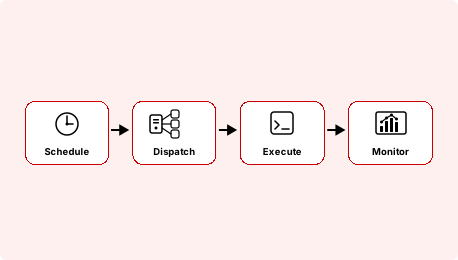
Open-source orchestration platform built on declarative YAML and an API-first architecture. Every workflow is a version-controlled file, deployable through CI/CD, and runnable by any team without waiting on a central operations group. React to events in real time or run on schedule in the same platform.
Centralized Enterprise Workload Scheduling
Enterprise workload automation platform organized around UPROCs (units of processing), Sessions, and Units. Jobs are defined and managed through a central GUI or CLI, deployed via agents on each target host, and operated by a dedicated automation team. A proven platform for large-scale overnight batch runs in regulated industries.
Batch Scheduling Manages What You Have.
Workflow Orchestration Builds What Comes Next.
Business-critical Workflows
- React to events as they happen, not on the next scheduled window
- Developer self-service with namespace isolation and RBAC
- Version-controlled workflows in Git, reviewed in pull requests
- Cross-functional: data pipelines + infrastructure + business processes
- No agent installation on target hosts
Enterprise Batch Workload Management
- Large-scale overnight batch job chains
- Central automation team manages all UPROC definitions
- Proprietary terminology (UPROC, SESS, UNIT) and tooling
- Agent required on every target execution host
- Enterprise-only licensing with high total cost of ownership
Time to First Workflow
Broadcom Dollar Universe requires server installation, a supported database backend, license server configuration, agent deployment to every target host, and familiarization with its UPROC/Session/Unit terminology before you can define and run your first job.
~5
Minutes
curl -o docker-compose.yml \https://raw.githubusercontent.com/kestra-io/kestra/develop/docker-compose.ymldocker compose up
# Open localhost:8080# Pick a Blueprint, run it. Done.Download the Docker Compose file, spin it up, and you're ready (database and config included). Open the UI, pick a Blueprint, run it. No agents to deploy, no proprietary terminology to learn.
~2
Days
# 1. Install Dollar Universe server (UNIXws) and configure database# 2. Activate license and configure license server
# 3. Install and register agent on each target host./du_agent_setup.sh --server du-server.corp:8080 --unit PROD_UNIX_01
# 4. Define a UPROC (unit of processing) via CLIuspuni ADD UPROC=DAILY_ETL \ UNIT=PROD_UNIX_01 \ CMD="python /etl/daily_report.py" \ SESS=BATCH_NIGHTLY \ SCAL=WORKDAYSRequires Dollar Universe server setup, database backend configuration, license server activation, agent installation and registration on each target host, and training on UPROC/Session/Unit concepts before the first job runs.
Workflows Your Whole Team Can Read
Kestra: Version-Controlled Workflows Anyone Can Read
YAML is readable on day 1. The AI Copilot writes workflows from a prompt, or start from our library of Blueprints. Every change goes through a pull request. No proprietary CLI syntax, no central team dependency.
Broadcom Dollar Universe: UPROC Definitions in a Proprietary CLI
Jobs are defined as UPROCs using Dollar Universe's own CLI (uspuni) or through the UniViewer GUI. There is no native Git integration. Changes go through the central automation team. UPROCs, Sessions, and Units are platform-specific concepts with no portable equivalent outside Dollar Universe.
One Platform for Your Entire Technology Stack
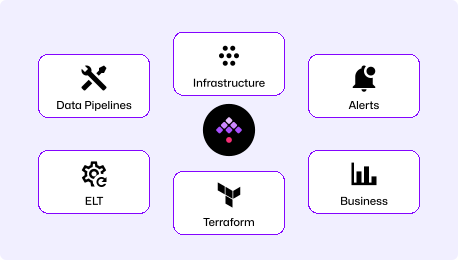
Orchestrate data pipelines, infrastructure operations, and business processes across any cloud or on-premises environment. Every execution is logged, traceable, and replayable directly from the UI.
Built for large-scale batch workload management in enterprise environments. Reliable for nightly job chains, file-based dependencies, and cross-platform scheduling. The central team operates the platform; individual developers interact through change requests or the GUI.
Kestra vs Broadcom Dollar Universe at a Glance
| | | |
|---|---|---|
| Primary use case | Universal workflow orchestration | Enterprise batch workload scheduling |
| Workflow definition | Declarative YAML (Git-native) | UPROC via uspuni CLI or UniViewer GUI (proprietary) |
| Languages supported | Agnostic (Python, SQL, R, Bash, Node.js & more) | Any language via shell command on target host |
| Architecture | Event-driven, API-first | Schedule-driven, agent-based |
| Agent deployment | No agents required | Agent required on every target host |
| Developer self-service | Kestra Apps | Central automation team only |
| Git and CI/CD integration | Native support | Not available |
| Infrastructure automation | Native support | Not designed for this |
| Open source | Apache 2.0 | Proprietary (Broadcom enterprise license) |
| Multi-tenancy and RBAC | Native namespace isolation | Available but centrally managed |
Kestra Is Built for How Modern Teams Work
Workflows in Git, not a proprietary GUI
Define workflows in YAML, commit to Git, review in pull requests, deploy through CI/CD. No UPROC to export, no change request to submit. Rollback is a git revert.
No agents, no host registration
Kestra executes tasks in isolated containers on its own workers. Add a new server or cloud environment without touching scheduler config or running an agent installer. Worker groups target namespaces, so routing production jobs to production infrastructure is a YAML field, not an agent configuration.
Every team owns their automation
Kestra's namespace isolation gives each team its own workspace with RBAC guardrails. A finance team and a data engineering team each manage their own workflows independently. The platform team sets policies without becoming the bottleneck for every job change.
The Right Tool for the Right Job
Choose Kestra When
- Your teams submit change requests to a central automation team for every job change. Self-service is the goal.
- You need event-driven triggers: file arrivals, webhook calls, API events, not just calendar-based batch windows.
- Workflows need to live in Git, go through pull request review, and deploy like the rest of your software.
- You're modernizing legacy batch workloads to modern data pipelines, dbt models, or cloud-native jobs.
- Open-source licensing and predictable pricing matter more than an existing enterprise support contract.
Choose Broadcom Dollar Universe When
- Your organization runs large-scale batch workloads in a regulated European industry and Dollar Universe is already the certified standard.
- You have a trained central automation team managing thousands of UPROCs and changing platforms would be high-risk and disruptive.
- Cross-platform batch scheduling across mainframe, Unix, Linux, and Windows is a core requirement with existing certified connectors.
- Long-term Broadcom enterprise support contracts and compliance certifications are organizational requirements.
Frequently asked questions
Find answers to your questions right here, and don't hesitate to Contact Us if you couldn't find what you're looking for.
Modernize Beyond Legacy Batch Scheduling
See how Kestra replaces centralized job schedulers with developer-friendly, event-driven orchestration.