/
Google Cloud

Kestra vs. Google Cloud Composer: Orchestrate Beyond Managed Airflow

Cloud Composer gives GCP-native teams managed Apache Airflow without running the infrastructure themselves. Kestra takes a different approach: declarative YAML orchestration that runs on any cloud, in any language, covering data pipelines, infrastructure automation, and business processes, without a 25-minute environment provisioning step before your first workflow runs.
kestra ui

Two Ways to Think About Managed Orchestration

Universal Orchestration: Any Cloud, Any Language

Declarative YAML orchestration with no cloud dependency baked into the architecture. Workflows describe what should run, not which managed services to wire together first. Python, SQL, Bash, R, and Go tasks run in isolated containers alongside GCP-native tasks, on any cloud or on-prem.

"How do we orchestrate data, infrastructure, and business workflows without being pinned to one cloud provider?"
Managed Apache Airflow on GCP

Apache Airflow, fully managed on Google Kubernetes Engine. Cloud Composer handles Airflow upgrades, GKE cluster management, and Cloud SQL provisioning. DAGs are stored in Cloud Storage, and GCP IAM controls access. The GCP integration runs deep: BigQuery, Dataflow, Cloud Run, and Pub/Sub are first-class targets, and Python is the only way to author them.

"How do we run Airflow on GCP without managing GKE clusters and Cloud SQL ourselves?"

GCP-Bound Pipeline Scheduling vs. Cloud-Agnostic Workflow Orchestration

Universal Workflows, Any Cloud
  • Data pipelines, infrastructure automation, business processes, AI workflows
  • Multi-language: Python, SQL, Bash, Go, Node.js, R
  • Event-driven at core: respond to Pub/Sub, S3, webhooks, database changes
  • Self-service for non-engineers via Kestra Apps
  • Runs on GCP, AWS, Azure, on-prem, or your laptop
Managed Airflow Inside GCP
  • Apache Airflow on GKE, managed by Google
  • Python DAGs stored in Cloud Storage
  • Deep GCP integration: BigQuery, Dataflow, Cloud Run, Pub/Sub
  • Data engineering scope
  • GCP-only deployment

Time to First Workflow

Cloud Composer is Google's fully managed Airflow service—there is no local or self-hosted install option. This comparison reflects what's required to provision a Composer environment: enabling the API, creating a service account with Composer Worker permissions, configuring IAM roles across five permission levels, and waiting roughly 25 minutes for the GKE-backed environment to provision.

~5

Minutes
curl -o docker-compose.yml \
https://raw.githubusercontent.com/kestra-io/kestra/develop/docker-compose.yml
docker compose up
# Open localhost:8080
# Pick a Blueprint, run it. Done.

Download the Docker Compose file, spin it up, and you're ready (database and config included). Open the UI, pick a Blueprint, run it. No GCP project, no service account, no IAM roles, no GCS bucket.

~45

Minutes

Enable the Cloud Composer API, create a service account with Composer Worker role, assign five IAM permission levels, create the Composer environment (~25 min to provision), then upload DAG files to the GCS bucket and wait for the Airflow scheduler to detect them.

Workflows Your Whole Team Can Read

Kestra: Readable by your whole team

YAML is readable on day 1. Our docs are embedded in the UI for easy reference, the AI Copilot writes workflows for you, or start with our library of Blueprints. No Python knowledge required to understand or modify a workflow.

Cloud Composer: Python DAGs in Cloud Storage, Airflow on GKE

DAG files are Python scripts stored in a GCS bucket. Updating a workflow means pushing a new file to Cloud Storage and waiting for the Airflow scheduler to detect the change. Operators, dependencies, and scheduling logic are all Python. Non-Python contributors can view runs in the Airflow UI but cannot author or edit workflows.

One Platform for Your Entire Technology Stack

Kestra Image

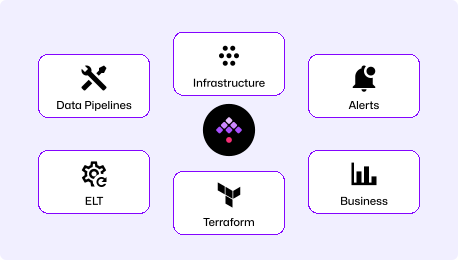
Orchestrate across data pipelines, infrastructure operations, business processes, and AI workflows in one unified platform. Event-driven at its core, with native triggers for Pub/Sub, GCS file arrivals, webhooks, Kafka, and database changes. Runs on any cloud or on-prem.

Competitor Image

Managed Airflow on GKE with first-class GCP integration. Excellent for Python-based data pipelines that target BigQuery, Dataflow, and Cloud Run. Infrastructure automation and business process workflows are possible via Python operators but are not first-class use cases. Runs exclusively on GCP.

Kestra vs. Cloud Composer at a Glance

Cloud Composer
Workflow definition Declarative YAML Python DAGs stored in Cloud Storage
Languages supported Any (Python, SQL, R, Bash, Go, Node.js) Python-first (Bash/SQL via operators)
Cloud dependency Runs anywhere (GCP, AWS, Azure, on-prem) GCP only
Setup requirements Docker Compose (two commands) API enable, IAM roles, service account, GKE environment (~45 min)
Architecture Event-driven at core Schedule-first (Airflow under the hood)
Airflow version control Your upgrade timeline Google controls Airflow version availability and cadence
Multi-tenancy Namespace isolation + RBAC out-of-box IAM-based access; separate Composer environments for strong isolation
Self-service for non-engineers
Kestra Apps
Airflow UI is observability-focused, no self-service authoring
Infrastructure automation
Native support
Possible via Python operators and GCP SDK, not a primary use case
We switched from Airflow because we want engineers solving problems, not coding orchestration. Kestra delivers end-to-end automation with the robustness we need at our scale. Few companies operate at this level, especially in AI/ML.
Senior Engineering Manager @ Apple (ML team)
200Engineers onboarded
2xFaster workflow creation
0Pipeline failures

Kestra Is Built for Teams Who Orchestrate Beyond GCP

No GKE cluster before your first workflow

Kestra runs in two Docker Compose commands. No GCP project to configure, no service account to provision, no IAM roles to assign across five permission levels, no 25-minute environment creation window. Teams get a production-shaped Kestra instance locally in under 5 minutes, using the same Docker-based deployment that scales to Kubernetes in production.

Not locked to a single cloud

When your pipelines pull from BigQuery but push to Snowflake or trigger infrastructure jobs on AWS, routing everything through a GCP-only control plane adds friction. Kestra runs on GCP, AWS, Azure, or your own data center, with native plugins for GCS, BigQuery, Pub/Sub, and every major GCP service alongside AWS and Azure targets.

Upgrade when you're ready

Kestra upgrades run on your schedule: pull a new image, test in staging, and ship when ready. No waiting for a managed service to certify a release or schedule a maintenance window. Roll back instantly if something unexpected surfaces after an upgrade.

The Right Tool for the Right Job

Choose Kestra When
  • Your team writes Python, SQL, Bash, and dbt, and you want orchestration that doesn't force everyone into Python DAGs.
  • You need workflows that span GCP, AWS, Azure, or on-prem without being locked to one cloud.
  • You want a local development environment in under 5 minutes, not 45 minutes of IAM and GKE configuration.
  • Your workflows span data pipelines, infrastructure automation, and business processes.
  • Non-engineers need to trigger or monitor workflows without writing Python.
Choose Cloud Composer When
  • Your team is fully invested in Airflow and your entire data stack runs on GCP.
  • Deep GCP integration is non-negotiable: IAM-controlled access, native BigQuery operators, and Dataflow orchestration from within the Airflow DAG.
  • GCP compliance requirements (data residency, VPC-SC, org-level IAM) make a fully managed GCP service the right choice.
  • Your existing Python DAG library and Airflow operator investments are too large to migrate near-term.

Frequently asked questions

Find answers to your questions right here, and don't hesitate to Contact Us if you couldn't find what you're looking for.

See How

Getting Started with Declarative Orchestration

See how Kestra can simplify your data pipelines—and run them on any cloud, not just GCP.