Kestra vs. Luigi: Orchestration Beyond Python Batch Jobs
Luigi gets batch jobs running. Kestra orchestrates everything around them: scheduling, event triggers, retries, and visibility across every team and tool.
Luigi gets batch jobs running. Kestra orchestrates everything around them: scheduling, event triggers, retries, and visibility across every team and tool.
YAML describes what should run, when, and in what order. Business logic stays in your existing Python scripts, SQL queries, Bash commands, or dbt models. Kestra handles scheduling, retries, dependencies, and observability as first-class YAML primitives. Any engineer on the team can read, modify, or trigger a workflow without understanding the orchestration layer.
Originally built by Spotify to manage complex batch pipeline dependencies at scale, Luigi is a lightweight Python library for defining jobs and their dependencies. Minimal by design: no built-in scheduler, no event triggers, no UI. Spotify has since moved on to other tools for its own production pipelines.
Luigi has no built-in scheduler. Getting a pipeline running on a schedule means installing the package, starting the luigid daemon separately, writing Task classes in Python, then wiring up cron yourself. Kestra ships with scheduling, a UI, and a database in a single Docker Compose.
curl -o docker-compose.yml \https://raw.githubusercontent.com/kestra-io/kestra/develop/docker-compose.ymldocker compose up
# Open localhost:8080# Pick a Blueprint, run it. Done.
Download the Docker Compose file, spin it up, and you're ready (database and config included). Open the UI, pick a Blueprint, run it. No Python environment to configure, no scheduler daemon to manage separately.
Install Luigi, start the luigid central scheduler daemon, then write your first Task class with output(), requires(), and run() methods. Add cron or a separate process manager to schedule recurring jobs. The framework is intentionally minimal, so production setup requires assembling the surrounding infrastructure yourself.
YAML is readable on day 1. Docs are embedded in the UI for easy reference, the AI Copilot writes workflows for you, or start with our library of Blueprints. No Python knowledge required to read, understand, or modify a workflow.
Every Luigi pipeline is a set of Python classes. Each task must define output(), requires(), and run() methods. Non-Python contributors cannot read or modify pipeline logic without understanding both Python and Luigi's class model. There is no visual editor, no YAML interface, and no built-in notification layer.
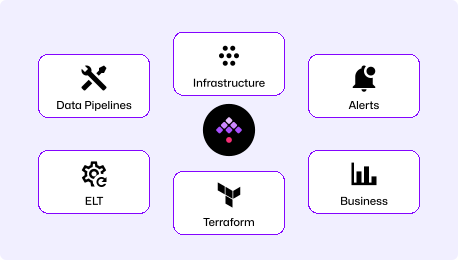
Orchestrate across data pipelines, infrastructure operations, business processes, and AI workflows in one unified platform. Event-driven at its core, with native triggers for S3 file arrivals, webhooks, Kafka messages, and database changes. The visual DAG editor updates live as you type YAML.
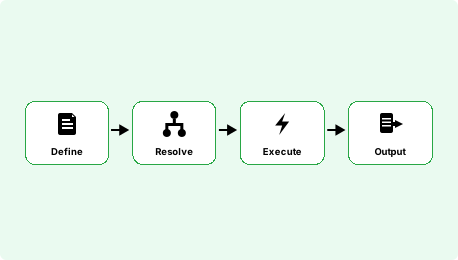
A Python batch pipeline framework focused on dependency resolution for scheduled jobs. The Luigi web UI visualizes task state and dependency graphs. Scheduling, event-driven triggers, and real-time notifications are not built in; they require external tooling layered on top of the framework.
| Workflow definition | Declarative YAML | Python classes (Task subclasses) |
| Languages supported | Any (Python, SQL, R, Bash, Go, Node.js) | Python only |
| Built-in scheduler | Native cron + event-driven triggers | No built-in scheduler (luigid coordinates tasks, scheduling via cron) |
| Architecture | Event-driven at core | Batch-only, dependency resolution on task outputs |
| Event-driven triggers | S3, Kafka, webhooks, DB changes, file arrivals | Not supported natively |
| Visual editor | Live DAG editor updates as you type | Read-only dependency graph visualization |
| Primary use case | Universal workflow orchestration | Batch pipeline dependency management |
| Multi-tenancy / RBAC | Namespace isolation + RBAC out-of-the-box | Not supported |
| Self-service for non-engineers | Kestra Apps | Not supported |
| Infrastructure automation | Native support | Possible via Python run() methods, not a primary use case |
| Open source | Full open-source core, self-hostable | ✓ Apache 2.0, community-maintained (Spotify moved to Flyte internally) |
Kestra has changed how we handle data orchestration. Instead of spending days fixing issues, we now have full visibility and control. As we scale, having a system that grows with us is invaluable

Bring your Python scripts, SQL queries, Bash commands, and R notebooks. Kestra orchestrates all of them in YAML. The orchestration definition is configuration; the business logic is yours, untouched.

Native triggers for S3 file arrivals, Kafka messages, webhooks, and database changes mean your workflows react to real business events the moment they happen, not on the next scheduled window.

Built-in execution logs, real-time metrics, Gantt charts, and distributed tracing come with Kestra out of the box. Your team gets full visibility into every execution without bolting on a separate observability stack.
Find answers to your questions right here, and don't hesitate to Contact Us if you couldn't find what you're looking for.
