/

Kestra vs. HPE Morpheus: Declarative Orchestration vs. Hybrid Cloud Management

HPE Morpheus is a hybrid cloud management platform that centralizes provisioning, monitoring, and cost governance behind a self-service portal. Kestra is an open-source orchestration engine that lets any engineer define, version, and deploy workflows in YAML. Different tools, different jobs.
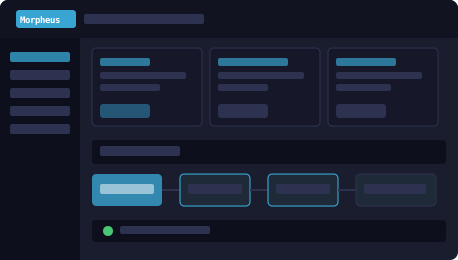
kestra ui

Orchestration Engine vs. Cloud Management Platform

Purpose-Built Workflow Orchestration

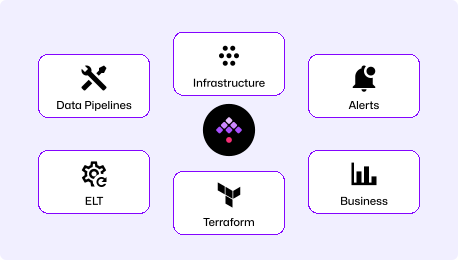
Declarative YAML workflows versioned in Git, executed in isolated containers, deployed through CI/CD. Orchestrate data pipelines, infrastructure automation, business processes, and AI workflows from one platform. Any engineer can build and ship workflows without waiting on a platform team.

"How do we let every team build, version, and ship workflows across data, infrastructure, and business processes?"
Unified Hybrid Cloud Management

HPE Morpheus provides a single pane of glass for provisioning, managing, and governing infrastructure across private and public clouds. Self-service catalogs, built-in CMDB, cost analytics, and brownfield discovery are bundled into one proprietary platform managed by a cloud operations team.

"How do we give developers a self-service portal for VMs, containers, and apps across every cloud while keeping costs and compliance in check?"

Workflow Orchestration vs. Cloud Operations Portal

Open-Source Orchestration
  • Data pipelines, infrastructure automation, business processes, and AI workflows in one platform
  • Any engineer ships workflows in YAML through Git and CI/CD
  • Event-driven at core: react to webhooks, file uploads, messages, and API events
  • Open source with 1200+ plugins, transparent pricing, and no vendor lock-in
  • Self-service for non-engineers via Kestra Apps with dynamic forms and approvals
Hybrid Cloud Management
  • Unified provisioning and lifecycle management across AWS, Azure, GCP, VMware, and bare metal
  • Built-in CMDB, monitoring, logging, and cost optimization in one platform
  • Self-service catalog for VMs, containers, Kubernetes clusters, and applications
  • Brownfield discovery automatically imports existing infrastructure into the platform
  • Proprietary licensing with per-workload pricing

Time to First Workflow

HPE Morpheus requires deploying an appliance, connecting cloud endpoints, configuring service plans and groups, and setting up the self-service catalog before users can provision anything. Kestra's single Docker Compose command stands up a production-shaped environment in minutes.

~5

Minutes
curl -o docker-compose.yml \
https://raw.githubusercontent.com/kestra-io/kestra/develop/docker-compose.yml
docker compose up
# Open localhost:8080
# Pick a Blueprint, run it. Done.

Download the Docker Compose file, spin it up, and you're ready (database and config included). Open the UI, pick a Blueprint, run it.

Hours to

Days
# 1. Deploy HPE Morpheus appliance (VM or AMI)
sudo rpm -i morpheus-appliance-x.x.x.el8.x86_64.rpm
sudo morpheus-ctl reconfigure
# 2. Access the HPE Morpheus UI at https://<appliance-ip>
# 3. Add cloud endpoints (AWS, Azure, vCenter, etc.)
# 4. Configure groups, service plans, and policies
# 5. Define instance types, layouts, and node types
# 6. Set up the self-service catalog
# 7. Create users, roles, and tenants

Production deployment requires installing the HPE Morpheus appliance (Ubuntu/CentOS VM or AWS AMI), configuring the embedded MySQL and Elasticsearch services, connecting cloud endpoints (AWS, Azure, vCenter), defining groups, service plans, and provisioning policies. The self-service catalog needs instance types, layouts, and node types configured before users can provision resources.

YAML Workflows vs. GUI-Driven Provisioning

Kestra: Any engineer, any language

YAML is readable on day 1. Our docs are embedded in the UI for easy reference, the AI Copilot writes workflows for you, or start with our library of Blueprints. Engineers deploy through Git, same as application code.

Morpheus: GUI-driven provisioning

HPE Morpheus provides a rich web UI for provisioning and managing infrastructure. Instance types, layouts, and node types are configured in the GUI or via the API. Morpheus supports Terraform, ARM, CloudFormation, and Helm as spec templates, but orchestration logic is defined through the task engine UI or API calls rather than declarative code files.

Open Orchestration vs. Proprietary Cloud Portal

Kestra Image

Orchestrate data pipelines, infrastructure operations, business processes, and AI workflows from a single open-source platform. Event-driven at its core, with native triggers for S3, webhooks, Kafka, database changes, and API events. 1200+ open-source plugins.

Competitor Image

HPE Morpheus unifies provisioning, monitoring, logging, CMDB, cost management, and governance for hybrid and multi-cloud environments. Strong brownfield discovery and lifecycle management across AWS, Azure, GCP, VMware, OpenStack, and bare metal. Proprietary platform with per-workload licensing.

Kestra vs. HPE Morpheus at a Glance

Primary purpose Workflow orchestration across data, infra, business, and AI Hybrid cloud management, provisioning, and governance
Workflow definition Declarative YAML (Git-native) GUI-driven tasks, API calls, or spec templates (Terraform, ARM, CloudFormation)
Architecture Event-driven orchestration engine Cloud management platform with provisioning, CMDB, and cost analytics
Deployment model Single Docker Compose (self-hosted or Kestra Cloud) HPE Morpheus appliance (VM or AMI) with embedded services
Licensing Open source (Enterprise tier available) Proprietary (per-workload pricing)
Self-service provisioning Kestra Apps with dynamic forms, approvals, and RBAC Built-in self-service catalog with policies and approvals
CMDB Via integrations (ServiceNow, HTTP API) Built-in CMDB with brownfield discovery
Cost management Not a primary use case Built-in cost analytics, budgets, and optimization recommendations
IaC support Native Terraform, Ansible, PowerShell, Pulumi plugins Terraform, ARM, CloudFormation, Helm as spec templates
Event-driven triggers Webhooks, schedules, S3, Kafka, database changes, flow triggers API-driven and schedule-based; no native event stream triggers
Brownfield discovery Not a primary use case Automatic import and management of existing cloud resources
Enterprise team modernizing with Kestra

We needed orchestration that went beyond provisioning VMs. With Kestra, our teams build workflows that span data ingestion, infrastructure operations, and business processes — all in YAML, all in Git, all visible. It replaced three separate tools.

Head of Platform Engineering @ Enterprise SaaS Company

3x

Faster workflow delivery

1

Platform for data, infra, and business workflows

70%

Reduction in manual operations
See how enterprises modernize IT automation with Kestra
Read the story

Kestra Is Built for How Modern Teams Work

Orchestration, not just provisioning

HPE Morpheus excels at provisioning and managing cloud resources. But modern teams need to orchestrate workflows that span data pipelines, infrastructure operations, business processes, and AI. Kestra is purpose-built for this: a single platform where a Terraform apply, a dbt run, an API call, and a Slack notification live in one declarative YAML flow.

Open source, transparent pricing

Kestra's open-source core is free with 1200+ plugins and unlimited event-driven workflows. Enterprise features (RBAC, SSO, audit logs, multi-tenancy) are available without per-workload metering. HPE Morpheus uses proprietary per-workload licensing that scales with the number of managed instances.

Event-driven from the start

Kestra was built event-driven from day one: webhooks, S3 uploads, Kafka messages, database changes, and API events are first-class YAML triggers. HPE Morpheus focuses on catalog-driven provisioning and scheduled tasks. When your automation needs to react to real-time events across systems, Kestra's architecture is purpose-built for it.

The Right Tool for the Right Job

Choose Kestra When
  • You need a general-purpose orchestration engine for workflows spanning data, infrastructure, business processes, and AI.
  • Developers should own their workflows in YAML and Git, not depend on a cloud ops team.
  • Event-driven automation is critical: reacting to webhooks, file uploads, messages, and API events in real time.
  • Open source and transparent pricing matter. No per-workload fees, no proprietary lock-in.
  • Non-engineers need to trigger and monitor workflows through self-service Apps without learning a new platform.
Choose HPE Morpheus When
  • You need a unified cloud management platform with provisioning, CMDB, monitoring, and cost governance in one tool.
  • Brownfield discovery is a priority — you need to import and manage existing cloud resources automatically.
  • A self-service provisioning catalog for VMs, containers, and applications is the primary requirement.
  • Built-in cost analytics, budget enforcement, and optimization recommendations are essential for your cloud strategy.
  • You manage infrastructure across VMware, AWS, Azure, GCP, OpenStack, and bare metal and need one operational console.

Frequently asked questions

Find answers to your questions right here, and don't hesitate to Contact us if you couldn't find what you're looking for.

See How

Getting Started with Declarative Orchestration

See how Kestra can simplify your workflows—beyond cloud management into true orchestration.