/

Kestra vs. Puppet: Workflow Orchestration vs. Configuration Management

Puppet enforces desired state on infrastructure through agents and a custom DSL. Kestra orchestrates workflows across data, infrastructure, business processes, and AI in declarative YAML. Different problems, different tools.
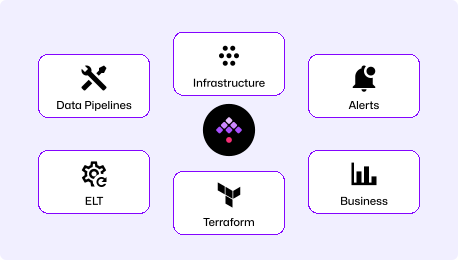
kestra ui

Orchestration vs. Configuration Management

Workflow Orchestration Platform

Declarative YAML workflows versioned in Git, executed in isolated containers, deployed through CI/CD. Orchestrate data pipelines, infrastructure operations, business processes, and AI workflows from a single platform. Event-driven at its core, with any engineer able to build and ship workflows without learning a custom DSL.

"How do we orchestrate workflows across teams, systems, and cloud providers without building custom glue code?"
Infrastructure Configuration Management

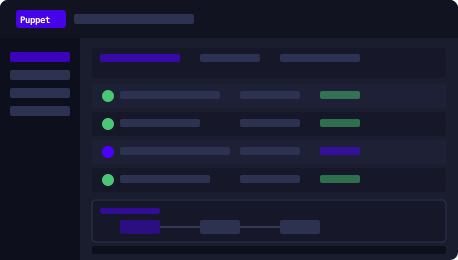
Agent-based platform that enforces desired state on managed nodes using Puppet DSL manifests. A Puppet Agent runs on every managed node, periodically pulling configurations from a Puppet Server and converging the node to the declared state. Strong at configuration drift detection and compliance enforcement.

"How do we ensure every server in our fleet is configured exactly the way we declared, and stays that way?"

Orchestrating Workflows vs. Managing Node State

Cross-Domain Workflow Orchestration
  • Data pipelines, infrastructure automation, business processes, and AI workflows in one platform
  • Event-driven triggers for webhooks, S3, Kafka, database changes, and API events
  • Any language: Python, SQL, R, Bash, Go, Node.js, and more
  • Open source with 1200+ plugins, transparent pricing, and a thriving community of contributors
  • Self-service for non-engineers via Kestra Apps
Infrastructure State Enforcement
  • Declarative configuration management for servers, packages, files, and services
  • Agent-based convergence loop enforces desired state every 30 minutes by default
  • Puppet Forge ecosystem with thousands of community and supported modules
  • Compliance enforcement and audit reporting for regulated environments
  • Configuration drift detection and automatic remediation

Time to First Workflow

Puppet Enterprise requires deploying a Puppet Server, installing Puppet Agents on every managed node, writing manifests in Puppet DSL, and configuring classification rules. Kestra's single Docker Compose command gives you a production-shaped environment in minutes.

~5

Minutes
curl -o docker-compose.yml \
https://raw.githubusercontent.com/kestra-io/kestra/develop/docker-compose.yml
docker compose up
# Open localhost:8080
# Pick a Blueprint, run it. Done.

Download the Docker Compose file, spin it up, and you're ready (database and config included). Open the UI, pick a Blueprint, run it.

Hours to

Days

Puppet Enterprise requires installing the Puppet Server (or PE monolithic install), deploying Puppet Agents on each managed node, writing Puppet DSL manifests, configuring node classification, and waiting for the first agent run to converge. The learning curve for Puppet DSL adds additional time before teams are productive.

Standard YAML vs. Custom DSL

Kestra: Any engineer, any language

YAML is readable on day 1. Our docs are embedded in the UI for easy reference, the AI Copilot writes workflows for you, or start with our library of Blueprints. Engineers deploy through Git, same as application code.

Puppet: DSL manifests for desired state

Puppet uses its own declarative DSL to define the desired state of infrastructure. Manifests describe resources (packages, files, services) and their relationships. The DSL is powerful for configuration management but requires learning Puppet-specific syntax, resource types, and concepts like classes, modules, and Hiera data lookups.

Workflow Platform vs. Node Configuration Tool

Kestra Image

Orchestrate data pipelines, infrastructure operations, business processes, and AI workflows from a single open-source platform. Event-driven at its core, with native triggers for S3, webhooks, Kafka, database changes, and API events. 1200+ open-source plugins.

Competitor Image

Agent-based configuration management platform that enforces desired state across infrastructure. Puppet Forge module ecosystem for packages, services, files, and cloud resources. Now owned by Perforce, with Puppet Enterprise providing RBAC, orchestration, compliance reporting, and node management at scale.

Kestra vs. Puppet at a Glance

Primary purpose Workflow orchestration Configuration management
Workflow definition Declarative YAML Puppet DSL (Ruby-based declarative language)
Architecture Event-driven, containerized execution Agent-based convergence loop (pull model)
Execution model On-demand, scheduled, or event-triggered Periodic convergence (default: every 30 min)
Deployment model Single Docker Compose (self-hosted or Kestra Cloud) Puppet Server + Agent on every managed node
Languages supported Any (Python, SQL, R, Bash, Go, Node.js) Puppet DSL, Ruby (for custom types and functions)
Licensing Open source (Enterprise tier available) Open source Puppet + Puppet Enterprise (commercial)
Self-service for non-engineers
Kestra Apps
Console UI for node management, not workflow triggers
Plugin ecosystem 1200+ plugins (cloud, databases, APIs, AI) Puppet Forge modules (infrastructure-focused)
Drift detection Not a primary use case ✓ Native configuration drift detection and remediation
Time to production Minutes (Docker Compose) Hours to days (Server + Agent deployment)
Enterprise team modernizing with Kestra

We needed something that could orchestrate across our entire stack, not just manage server configs. Kestra gave us a single platform for data pipelines, infrastructure operations, and business workflows. Our teams went from writing custom scripts to shipping production workflows in days.

Platform Engineering Lead @ Fortune 500 Technology Company

70%

Reduction in custom glue code

1200+

Plugins available out of the box

5x

Faster workflow delivery
See how enterprises modernize IT automation with Kestra
Read the story

Kestra Is Built for How Modern Teams Work

Orchestration, not just configuration

Puppet manages what a node looks like. Kestra orchestrates what happens across systems. Provision infrastructure, run data pipelines, trigger business processes, and coordinate AI workflows in a single DAG. Multi-step workflows with dependencies, retries, error handling, and conditional branching are first-class concepts.

No agents, no DSL to learn

Puppet requires an agent on every managed node and a custom DSL to define configurations. Kestra runs tasks in isolated Docker containers with no agents to install or maintain. Workflows are written in standard YAML that any engineer can read and modify on day one, with any scripting language supported inside tasks.

Event-driven beyond periodic runs

Puppet agents pull configurations on a fixed interval (default 30 minutes). Kestra reacts to events in real time: webhooks, S3 uploads, Kafka messages, database changes, and API events are first-class YAML triggers. Combine scheduled, event-driven, and manual workflows in one platform.

The Right Tool for the Right Job

Choose Kestra When
  • You need to orchestrate multi-step workflows across systems, not just enforce node state.
  • You want event-driven automation that reacts to real-time events, not just periodic convergence.
  • Any engineer should be able to build workflows in standard YAML without learning a custom DSL.
  • You need to coordinate data pipelines, business processes, AI workflows, and infrastructure operations in one platform.
  • Non-engineers need to trigger and monitor workflows through a self-service interface.
Choose Puppet When
  • You need to enforce desired state across thousands of nodes with automatic drift remediation.
  • Compliance and audit enforcement is a primary requirement for your infrastructure.
  • You manage a large fleet of servers and need consistent package, file, and service configuration.
  • Your team is already invested in the Puppet ecosystem with existing modules and Hiera data.
  • You need continuous configuration enforcement, not just one-time provisioning.

Frequently asked questions

Find answers to your questions right here, and don't hesitate to Contact us if you couldn't find what you're looking for.

See How

From Configuration Management to Workflow Orchestration

See how Kestra can orchestrate your infrastructure automation—including Puppet—in declarative YAML workflows.