/

Kestra vs. Redwood RunMyJobs: Open-Source Orchestration vs. SaaS Workload Automation

Redwood RunMyJobs is a SaaS-first platform that automates enterprise workloads, especially SAP environments. Kestra gives any engineer the power to build, deploy, and monitor workflows in YAML through Git. No vendor lock-in, no per-job metering.
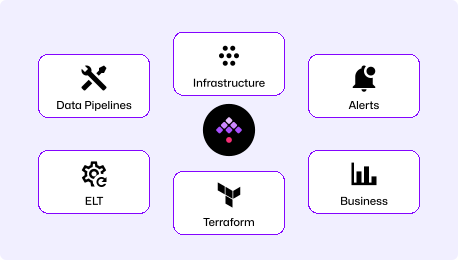
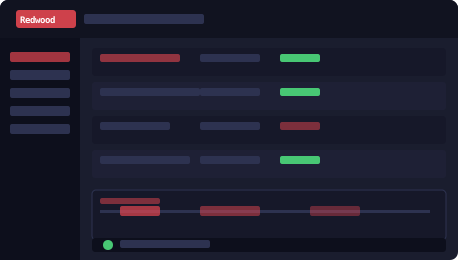
kestra ui

Two Approaches to Automation

Developer Self-Service Orchestration

Declarative YAML workflows versioned in Git, executed in isolated containers, deployed through CI/CD. Any engineer can build and ship workflows without waiting on a vendor or central team. Open source at the core, with 1200+ plugins and event-driven triggers built in from day one.

"How do we let every team build and ship workflows without being locked into a single vendor or SaaS platform?"
SaaS-First Workload Automation

Cloud-native SaaS platform focused on enterprise job scheduling and SAP workload automation. Jobs are defined through a GUI, executed by the RunMyJobs engine, and monitored from a centralized console. SAP-certified with deep integration into SAP ECC, S/4HANA, and BW environments.

"How do we replace our legacy scheduler with a managed SaaS platform that handles SAP and enterprise workloads?"

Open Platform vs. Managed SaaS

Self-Service Automation
  • Data pipelines, infrastructure automation, business processes, and AI workflows
  • Any engineer ships workflows in YAML through Git and CI/CD
  • Event-driven at core: react to real events, not just batch schedules
  • Open source with 1200+ plugins, no per-job licensing, and a thriving community of contributors
  • Self-service for non-engineers via Kestra Apps
Enterprise SaaS Scheduling
  • Enterprise job scheduling with SAP-certified integration
  • SaaS-delivered platform with no on-premise infrastructure to manage
  • Finance close automation and compliance-focused workflows
  • Proprietary subscription licensing with usage-based pricing
  • GUI-driven job definition managed through a centralized console

Time to First Workflow

Redwood RunMyJobs is a SaaS platform that requires procurement, onboarding, and configuration before you can define your first job. Kestra's single Docker Compose command stands up everything in a format that's already production-shaped.

~5

Minutes
curl -o docker-compose.yml \
https://raw.githubusercontent.com/kestra-io/kestra/develop/docker-compose.yml
docker compose up
# Open localhost:8080
# Pick a Blueprint, run it. Done.

Download the Docker Compose file, spin it up, and you're ready (database and config included). Open the UI, pick a Blueprint, run it.

Weeks to

Months
# 1. Negotiate contract and subscription terms
# 2. Provision your RunMyJobs SaaS tenant
# 3. Install connectivity components for on-premise systems
# 4. Configure SAP RFC connections (if applicable)
# 5. Set up user roles and security policies
# 6. Define jobs through the RunMyJobs GUI
# 7. Schedule and test job chains
# No self-hosted option or free trial available

As a SaaS platform, RunMyJobs handles infrastructure, but onboarding involves procurement, contract negotiation, tenant provisioning, SAP system connectivity setup, and user training. Connecting on-premise systems requires installing Redwood's connectivity components. There is no free tier or self-service trial to get started immediately.

YAML in Git vs. GUI-Defined Jobs

Kestra: Any engineer, any language

YAML is readable on day 1. Our docs are embedded in the UI for easy reference, the AI Copilot writes workflows for you, or start with our library of Blueprints. Engineers deploy through Git, same as application code.

Redwood: GUI-defined job chains

Jobs are defined through the RunMyJobs web console using a graphical interface. Job chains establish dependencies between steps. Process definitions include parameters, scheduling rules, and alerting configurations. Modifying job logic requires access to the RunMyJobs GUI and appropriate permissions.

Open Platform vs. Proprietary SaaS

Kestra Image

Orchestrate data pipelines, infrastructure operations, business processes, and AI workflows from a single open-source platform. Event-driven at its core, with native triggers for S3, webhooks, Kafka, database changes, and API events. 1200+ open-source plugins.

Competitor Image

SaaS-first enterprise workload automation with SAP-certified integration, finance close automation, and cloud job scheduling. Proprietary platform with subscription-based licensing and a GUI-driven approach to job definition and monitoring.

Kestra vs. Redwood at a Glance

Workflow definition Declarative YAML GUI-driven process definitions
Architecture Event-driven at core SaaS-first, schedule-driven
Deployment model Single Docker Compose (self-hosted or Kestra Cloud) SaaS-only (connectivity components for on-premise systems)
Licensing Open source (Enterprise tier available) Proprietary subscription (usage-based pricing)
Languages supported Any (Python, SQL, R, Bash, Go, Node.js) Scripts via job types (Python, shell, SQL)
SAP integration Via JDBC and script plugins SAP-certified native integration
Self-service for developers Engineers build and deploy via Git GUI access with role-based permissions
Self-service for non-engineers Kestra Apps Monitoring dashboards, not self-service triggers
Open-source option Open source (Apache 2.0), Enterprise tier available No open-source option
Finance close automation Buildable with workflow orchestration Purpose-built finance close module
Time to production Minutes (Docker Compose) Weeks to months (SaaS onboarding + connectivity setup)
Enterprise team modernizing with Kestra

Replacing our legacy scheduler with Kestra meant our engineers could finally own their workflows. We went from weeks of back-and-forth with a central team to self-service deployment through Git. The open-source model gave us full visibility into what we were running.

Platform Engineering Lead @ Enterprise Manufacturing Company

70%

Faster workflow deployment

1200+

Open-source plugins available

5x

More teams building automation
See how enterprises modernize IT automation with Kestra
Read the story

Kestra Is Built for How Modern Teams Work

No vendor lock-in, no black box

Redwood RunMyJobs is a proprietary SaaS platform. Your job definitions, execution history, and automation logic live inside their system. Kestra is open source. Workflows are YAML files in your Git repository. You own the code, the data, and the deployment. Run it on Docker, Kubernetes, or Kestra Cloud.

Open source, transparent pricing

Kestra's open-source core is free with 1200+ plugins. Enterprise features (RBAC, SSO, audit logs) are available without per-job metering. Redwood's proprietary licensing uses subscription-based pricing with usage tiers that can scale costs unpredictably as job volumes grow.

Event-driven, not just scheduling

Kestra was built event-driven from the start: webhooks, S3 uploads, Kafka messages, database changes, and API events are first-class YAML triggers. Unlimited event-driven workflows in open source. Redwood RunMyJobs is primarily a job scheduler. While it supports event-based triggers, the platform's core architecture is built around scheduled job execution.

The Right Tool for the Right Job

Choose Kestra When
  • You want developers to build and ship workflows themselves through Git and CI/CD, not through a vendor's GUI.
  • You need event-driven orchestration that reacts to real-time events, not just cron and batch schedules.
  • Open source and transparent pricing matter. No per-job fees, no proprietary lock-in.
  • You want to orchestrate across clouds, data platforms, and infrastructure with 1200+ plugins.
  • Non-engineers need to trigger and monitor workflows without learning a new tool.
Choose Redwood When
  • You have deep SAP environments (ECC, S/4HANA, BW) and need SAP-certified job scheduling.
  • You want a fully managed SaaS platform with no infrastructure to maintain.
  • Finance close automation is a primary use case and you need purpose-built tooling for it.
  • You are replacing a legacy scheduler and prefer a vendor-managed migration path.
  • Your organization prefers a GUI-driven approach and does not require developer self-service through code.

Frequently asked questions

Find answers to your questions right here, and don't hesitate to Contact us if you couldn't find what you're looking for.

See How

Getting Started with Declarative Orchestration

See how Kestra can simplify your workflows—and scale beyond legacy workload automation.