Kestra vs. SimplyAsk: Infrastructure Orchestration vs. Business Process Automation

SimplyAsk (Symphona) is a no-code platform for operations teams in telecom, manufacturing, and local government. Kestra is a general-purpose orchestration platform for engineering teams that need data pipelines, infrastructure automation, and technical workflows at production scale.
Two Platforms, Two Problem Shapes

Engineering-Grade Orchestration for Technical Workflows

Declarative YAML orchestration platform for engineering teams. Define data pipelines, infrastructure automation, and event-driven workflows in version-controlled YAML. Language-agnostic, self-hosted or on Kestra Cloud, with GitOps and full audit trails.

"How do I orchestrate technical workflows my engineering team can version, review, and operate like any other infrastructure?"
No-Code Automation for Business Operations

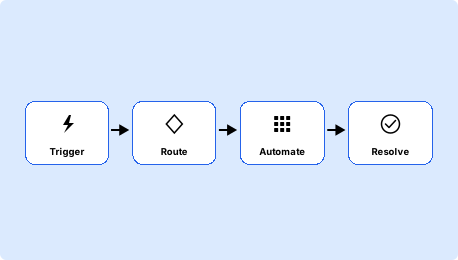
Bundled no-code platform for operations teams. Drag-and-drop canvas lets business analysts automate customer service flows, order management, and service tickets without writing code. Purpose-built for telecom OSS/BSS processes and vertical-specific business operations.

"How do I let my operations team automate business processes without waiting on engineering?"

No-Code Automation Serves Business Operations.
Engineering Orchestration Serves Technical Infrastructure.

Production-Grade Workflow Orchestration
  • Automate data pipelines, infrastructure, and business processes in one platform
  • Language-agnostic: run Python, Bash, SQL, R, or any script in isolated containers
  • GitOps-native: version control, CI/CD, and Terraform for all workflows
  • Self-hosted (Docker, Kubernetes) or Kestra Cloud, with air-gapped deployment support
  • Handles 100,000+ concurrent tasks with horizontal scaling and exactly-once execution
No-Code Business Process Automation
  • Drag-and-drop canvas for operations teams with no coding required
  • Bundled Symphona suite (Converse, Flow, Serve, Resolve) for telco and business ops
  • Credit-based pricing starting at $1,000/month for 25,000 process steps
  • SaaS-only deployment, no self-hosted or air-gapped option
  • Built for telecom OSS/BSS workflows, manufacturing, and local government operations

Time to First Workflow

SimplyAsk Symphona is SaaS-only, with no self-hosted option. Engineers who need to run workflows locally, deploy in air-gapped environments, or integrate with infrastructure tooling like Terraform and Ansible have no path forward. Kestra runs in two commands.

~5

Minutes
curl -o docker-compose.yml \
https://raw.githubusercontent.com/kestra-io/kestra/develop/docker-compose.yml
docker compose up
# Open localhost:8080
# Pick a Blueprint, run it. Done.

Download the Docker Compose file, spin it up, and you're ready (database and config included). Open the UI, pick a Blueprint, run it. No vendor coordination, no infrastructure prerequisites beyond Docker.

~15

Minutes
# SimplyAsk Symphona is SaaS-only
# 1. Sign up at simplyask.ai (7-day free trial)
# 2. Log in to Symphona dashboard
# 3. Open Flow, drag-and-drop process steps onto canvas
# 4. Configure triggers: schedule, API, email, or webhook
# No local installation or self-hosted option available
# Minimum paid plan: $1,000/month (25,000 process steps)

Sign up for a Symphona account at simplyask.ai to start a 7-day free trial. Workflows are built visually in the Flow canvas. No local installation option; all automation runs in SimplyAsk's SaaS environment.

Built for Engineers vs. Built for Operations

Kestra: Readable by your whole team

YAML is readable on day 1. Docs are embedded in the UI for easy reference, the AI Copilot writes workflows for you, or start from our library of 200+ Blueprints. Engineers bring their existing scripts with no wrappers or refactoring required.

SimplyAsk: No-code canvas for business ops
# SimplyAsk Flow has no code representation.
# Workflows are built visually and stored internally
# in SimplyAsk's proprietary SaaS format.
# To integrate infrastructure tooling (Terraform, Ansible,
# Kubernetes), you must wrap all operations in REST API calls.
# There is no native shell execution or container support.
# Example: to run a Terraform plan, you would need to:
# 1. Wrap the Terraform CLI in a custom REST API service
# 2. Call that API from a Flow HTTP action step
# 3. Poll a second endpoint to check for completion

SimplyAsk Flow workflows are built by dragging steps onto a visual canvas. Supported integrations need no code; complex logic is configured through form-based condition builders. Workflows are stored in SimplyAsk's proprietary format with no code export or version control.

One Platform for Your Entire Technology Stack

Kestra Image

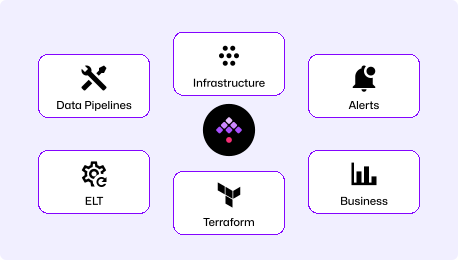
Orchestrate data pipelines, infrastructure provisioning, business processes, and event-driven automations in one platform. Self-host with full control or use Kestra Cloud.

Competitor Image

Purpose-built for business process automation in telecom, manufacturing, and local government. Strong for customer service flows, order management, and service ticketing. Not designed for data pipelines, shell execution, infrastructure provisioning, or engineering-team GitOps.

Kestra vs SimplyAsk at a Glance

Primary use case Universal workflow orchestration Business process automation (telco and operations)
Workflow definition Declarative YAML Visual no-code drag-and-drop canvas
Target user Engineers, data teams, platform teams Operations teams, business analysts
Languages supported Agnostic (Python, R, Bash, Node.js, SQL & more) No-code (REST API calls only for custom logic)
Infrastructure automation
Native support (Terraform, Ansible, Bash, containers)
Out of scope; built for business operations, not infrastructure tooling
Data pipeline support
Native support (ETL, dbt, Spark, Airbyte)
Not designed for data workloads
GitOps and CI/CD
Native Git sync, Terraform provider
No Git integration, no code review workflow
Self-hosted deployment
Docker, Kubernetes, air-gapped support
SaaS only, no self-hosted option
Open source
Open source (Apache 2.0)
Closed source, proprietary SaaS
Self-service for non-engineers
Kestra Apps
✓ Visual canvas for operations analysts
Multi-tenancy and RBAC
Enterprise namespace isolation
Enterprise plan only
Kestra made the data mesh possible. We produce far more data now, and deliver it nearly 10 times faster.
Julien Henrion, CDO @ Leroy Merlin
+900%In data production
+250Active users
+5000Workflows created

Kestra Is Built for Engineering Teams

Workflows in Git, promoted like code

Every Kestra flow is a YAML file that lives in a repository, moves through a CI/CD pipeline, and promotes from dev to staging to production the same way application code does. Every change is tracked, reviewed in a pull request, and auditable. Automation gets the same engineering rigor as the infrastructure it controls.

Native shell, container, and IaC execution

Terraform plans, Ansible playbooks, Bash scripts, and Docker containers all run natively in Kestra. Tasks execute in isolated containers, so existing scripts work without wrappers or refactoring. Bring the code, define the trigger and retry logic in YAML, and run it. Infrastructure automation from provisioning through configuration to notification can live in a single workflow.

Open source with a public codebase

Kestra is open source under Apache 2.0, with 26k+ GitHub stars and a codebase you can inspect, extend, and deploy anywhere. Self-hosting is available on Docker, Kubernetes, and in air-gapped environments with no outbound internet access required. For teams making long-term infrastructure investments, an open community and a permissive license are a different foundation than a proprietary SaaS platform.

The Right Tool for the Right Job

Choose Kestra When
  • Your team runs Terraform, Ansible, Bash scripts, or containerized tasks as part of a workflow.
  • Workflows should live in version control and deploy through CI/CD like any other infrastructure.
  • You need self-hosting that works in Docker, Kubernetes, or air-gapped environments.
  • Your engineers author the workflows. YAML and Git are the standard, not a visual canvas.
  • You need data pipelines, ETL, or infrastructure automation alongside event-driven triggers.
Choose SimplyAsk When
  • Your primary use case is telco business process automation: order management, service provisioning, customer ops.
  • Your team is operations analysts or customer service managers who need to build workflows without engineering support.
  • You want a bundled suite covering chat agents, service ticketing, and workflow automation in one SaaS package.
  • No-code matters more than GitOps. Your team will not write or review YAML.
  • You're in telecom, manufacturing, or local government and want out-of-the-box workflow templates for those verticals.

Frequently asked questions

Find answers to your questions right here, and don't hesitate to Contact Us if you couldn't find what you're looking for.

See How

Getting Started with Declarative Orchestration

See how Kestra can simplify your workflows—and scale beyond no-code business process automation.