Getting Started with Declarative Orchestration
See how Kestra can simplify your workflows—and scale beyond legacy workload automation.
Stonebranch Universal Automation Center centralizes workload automation behind agents and a Universal Controller. Kestra lets any engineer build and ship workflows in YAML. No agents, no proprietary licensing, no vendor lock-in.
Declarative YAML workflows versioned in Git, executed in isolated containers, deployed through CI/CD. Existing scripts, ETL jobs, and file transfers run as-is. Any engineer can build and ship workflows without filing a ticket or installing an agent.
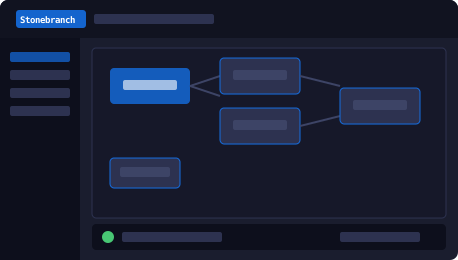
Universal Automation Center combines a Universal Controller for centralized scheduling with Universal Agents deployed across target systems. Jobs are defined through the UAC web interface, scheduled by the Controller, and executed by agents on each host. Changes flow through the operations team.
Stonebranch UAC requires deploying the Universal Controller, configuring a database backend, and installing Universal Agents on each target host before any job can execute. Kestra's single Docker Compose command stands up everything in a format that's already production-shaped.
curl -o docker-compose.yml \https://raw.githubusercontent.com/kestra-io/kestra/develop/docker-compose.ymldocker compose up
# Open localhost:8080# Pick a Blueprint, run it. Done.Download the Docker Compose file, spin it up, and you're ready (database and config included). Open the UI, pick a Blueprint, run it.
# 1. Request trial access through Stonebranch sales# 2. Install Universal Controller (scheduling engine)# 3. Configure backend database (Oracle, SQL Server, or PostgreSQL)# 4. Install Universal Agent on each target host# 5. Configure agent-controller connectivity and certificates# 6. Set up security policies, user roles, and credentials# 7. Define jobs through the UAC web interfaceProduction deployment requires installing the Universal Controller (scheduling engine), configuring the backend database, and deploying Universal Agents on every target host. Network connectivity, firewall rules, and security certificates must be configured between each agent and the controller. Trial downloads are gated behind a sales contact form.
YAML is readable on day 1. Our docs are embedded in the UI for easy reference, the AI Copilot writes workflows for you, or start with our library of Blueprints. Engineers deploy through Git, same as application code.
Jobs are primarily defined through the UAC web interface with form-based task creation. Universal Tasks and Universal Templates allow reuse, but orchestration logic is configured through the GUI and stored in the controller database. Exporting jobs for version control requires additional tooling.
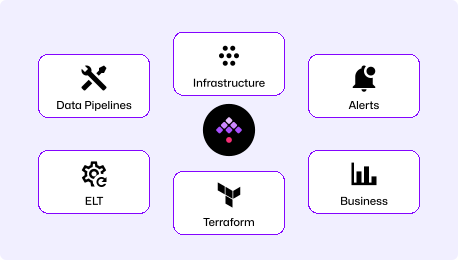
Orchestrate data pipelines, infrastructure operations, business processes, and AI workflows from a single open-source platform. Event-driven at its core, with native triggers for S3, webhooks, Kafka, database changes, and API events. 1200+ open-source plugins.
Enterprise workload automation across mainframe, SAP, and hybrid cloud environments. Strong legacy system coverage with Universal Connectors for SAP, PeopleSoft, and managed file transfer. Proprietary platform with agent-based architecture and capacity-based licensing.
| | ||
|---|---|---|
| Workflow definition | Declarative YAML | GUI-based task definitions in Universal Controller |
| Architecture | Event-driven at core | Event-driven triggers with agent-based execution |
| Deployment model | Single Docker Compose (self-hosted or Kestra Cloud) | Universal Controller + Universal Agents on each host |
| Licensing | Open source (Enterprise tier available) | Proprietary (capacity-based and per-agent licensing) |
| Languages supported | Any (Python, SQL, R, Bash, Go, Node.js) | Shell scripts, Python, PowerShell via Universal Tasks |
| Self-service for developers | Engineers build and deploy via Git | Ops-mediated (developers can use REST API for integration) |
| Self-service for non-engineers | Kestra Apps | Self-Service Portal for job triggering and monitoring |
| SAP integration | Via plugins and scripting | Native SAP job scheduling (BW, ABAP, PI) |
| Managed file transfer | Via plugins (S3, GCS, SFTP) | Native MFT with SFTP, FTP/SSL, PGP, AS2 |
| Mainframe support | Not a primary use case | Native mainframe job scheduling (z/OS, AS/400) |
| Time to production | Minutes (Docker Compose) | Days to weeks (multi-component install) |
Stonebranch requires installing and maintaining Universal Agents on every target host, with changes routed through a central operations team. Kestra runs tasks in isolated Docker containers. Engineers deploy through Git and CI/CD, the same way they deploy application code.
Kestra's open-source core is free with 1200+ plugins. Enterprise features (RBAC, SSO, audit logs) are available without per-agent metering. Stonebranch's proprietary licensing uses capacity-based pricing with per-agent costs that scale with your infrastructure footprint.
Kestra was built event-driven from the start: webhooks, S3 uploads, Kafka messages, database changes, and API events are first-class YAML triggers. Unlimited event-driven workflows in open source. Stonebranch offers event-driven triggers for file arrivals and system events, but the core architecture centers on the Universal Controller as a centralized scheduling engine.
Find answers to your questions right here, and don't hesitate to Contact us if you couldn't find what you're looking for.
See how Kestra can simplify your workflows—and scale beyond legacy workload automation.