Hi! I'm your Kestra AI assistant. Ask me anything about workflows.
EXAMPLE QUESTIONS
How to configure my internal storage?
What are main differences between Open Source and Enterprise?
How to write expression for previous tasks outputs?
/
Kestra vs. Temporal: Orchestration for Every Team, Not Just Every Engineer
Temporal is a durable execution platform built for engineers who want to express long-running, stateful workflows in code. Kestra is a declarative orchestration platform built for teams who want to schedule, trigger, and monitor workflows in YAML, without writing SDK code or managing workflow state by hand.
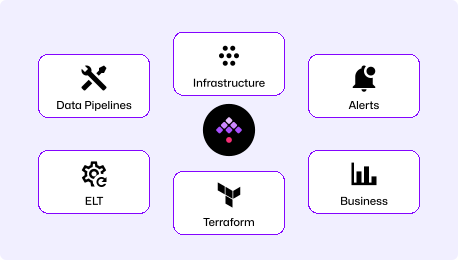
YAML describes what should run, when, and in what order. Business logic lives in your existing Python, SQL, Bash, or dbt scripts. Kestra handles scheduling, retries, dependencies, and observability as first-class YAML primitives. Non-engineers can read, trigger, and monitor any workflow without touching code.
"How do we schedule and monitor data pipelines, infrastructure jobs, and business workflows without writing orchestration code?"
Durable Execution Through Code
Temporal workflows are code: Go, Java, Python, TypeScript, or Ruby functions decorated with durability guarantees. The Temporal server persists state at every step, so workflows survive crashes and resume exactly where they left off. This makes Temporal exceptionally strong for long-running stateful processes, compensation patterns, and distributed application logic that must be expressed in a programming language.
"How do we build long-running, stateful workflows in code that survive infrastructure failures without writing retry logic everywhere?"
Durable Application Workflows vs. Declarative Team Orchestration
Orchestration for the Whole Team
Data pipelines, infrastructure automation, business processes, AI workflows
Multi-language: Python, SQL, Bash, Go, Node.js, R (run scripts directly, no SDK)
Event-driven at core: file arrivals, Kafka, webhooks, schedules
Self-service for non-engineers via Kestra Apps
1200+ plugins: dbt, Airbyte, Snowflake, Spark, Kafka, and more
Temporal
Durable Workflow Execution for Engineers
Long-running, stateful workflows that survive infrastructure failures
Workflow-as-code in Go, Java, Python, TypeScript, Ruby, C#, PHP
Built-in saga patterns and compensating transactions
Strong fit for microservices orchestration and distributed application logic
No native data pipeline tooling or YAML interface
Temporal is the right choice when you need long-running stateful workflows expressed in code, durable execution across infrastructure failures, or saga/compensation patterns in a distributed system. Kestra is the right choice for data pipelines, ETL orchestration, infrastructure automation, and any workflow that benefits from declarative YAML and participation from non-engineering teams.
Time to First Workflow
Temporal also offers Temporal Cloud, a fully managed SaaS option. This comparison uses their self-hosted local development path—the same deployment model as Kestra's local setup—which requires installing the Temporal CLI, starting a development server, and writing Workflow and Activity code before anything runs.
Download the Docker Compose file, spin it up, and you're ready (database and config included). Open the UI, pick a Blueprint, run it. No SDK to install, no workflow code to write before you can see anything execute.
Install the Temporal CLI, start a local development server, choose a language SDK, set up your project structure, write Workflow and Activity definitions in code, then register and run the worker. Each step requires language-specific tooling.
messageText: "ETL complete: {{ outputs.extract.vars.result.records }} records processed"
triggers:
- id: daily
type: io.kestra.plugin.core.trigger.Schedule
cron: "0 0 * * *"
YAML is readable on day 1. Our docs are embedded in the UI for easy reference, the AI Copilot writes workflows for you, or start with our library of Blueprints. Any team member can read the YAML and understand what a workflow does, no SDK knowledge required.
Temporal
Temporal: Workflow logic lives in application code
Temporal workflows are Python (or Go, Java, TypeScript) classes decorated with durability primitives. Activities handle individual tasks; Workflows coordinate them. The code is clean and testable, but authoring and modifying workflows requires SDK knowledge. Non-engineers can view execution history in the Temporal Web UI but cannot modify workflow logic.
Two Platforms, Two Jobs to Be Done
Orchestrate data pipelines, infrastructure operations, business processes, and AI workflows from one platform. Event-driven at its core, with native triggers for file arrivals, Kafka, webhooks, and schedules, all defined in YAML alongside the workflow logic.
Temporal
A durable execution engine for long-running stateful workflows expressed in code. Strong for saga patterns, distributed application logic, and workflows that need to survive infrastructure failures across days or weeks. Not designed for data pipeline orchestration or participation from non-engineers.
Kestra Is Built for the Workflows That Run Your Business
Data pipeline tooling out of the box
Kestra ships with native plugins for dbt, Airbyte, Spark, Snowflake, BigQuery, Kafka, Databricks, and 1200+ more. Run a dbt model, trigger an Airbyte sync, or load to Snowflake in a YAML task with no extra SDK to install. Every integration is a pre-built task type, not custom code your team writes and maintains.
Workflows non-engineers can participate in
A Kestra workflow is a YAML file that any team member can read and understand. Kestra Apps let business users trigger workflows, fill in parameters, and monitor results without engineering involvement. RBAC and namespace isolation keep business-user workflows separate from engineering infrastructure without restricting access to either.
Scheduling and event triggers as first-class primitives
Kestra's trigger system covers cron schedules, file arrivals in S3 or GCS, Kafka message consumption, webhook callbacks, and database row changes, all defined in YAML alongside the workflow. Triggers, tasks, and retry logic live in one file with no separate scheduling API or external coordinator required.
Two Tools for Different Problems
Choose Kestra When
You're orchestrating data pipelines, ETL workflows, dbt models, or infrastructure automation.
Your team includes data engineers, analysts, and ops who shouldn't need to learn an SDK to modify a workflow.
You want scheduling, event triggers, and monitoring defined declaratively alongside the workflow logic.
Non-engineers need to trigger or monitor workflows without writing code.
You need 1200+ pre-built integrations without writing and maintaining custom Activities.
Temporal
Choose Temporal When
You're building long-running, stateful workflows (days to weeks) that must survive infrastructure failures.
Your team is building distributed systems and needs saga patterns, compensating transactions, or exact-once execution guarantees.
Workflows are core application logic owned by engineers, written and tested in Go, Java, Python, or TypeScript.
You need deterministic replay for debugging complex distributed failures.
Frequently asked questions
Find answers to your questions right here, and don't hesitate to Contact Us if you couldn't find what you're looking for.
For most data and infrastructure workflows, yes. Kestra handles retries, timeouts, failure handling, and multi-step dependencies across any duration in YAML. For workflows that need deterministic replay, exact-once distributed state persistence, or compensation patterns built into application code, Temporal is purpose-built for those requirements. The distinction is between orchestrating external scripts and tools (Kestra's strength) versus building durable stateful logic inside application code (Temporal's strength).
Kestra runs tasks in any language without an SDK. Python scripts, Go binaries, Bash commands, SQL queries, and R notebooks execute in isolated containers with no framework wrappers. Temporal's SDKs (Go, Java, Python, TypeScript, Ruby, C#, PHP) are required to author workflow and activity logic. Kestra's approach keeps your business logic portable; Temporal's approach gives you deeper durability guarantees inside the workflow execution model.
Kestra supports per-task retry policies with configurable attempt counts, backoff strategies, and retry conditions, all declared in YAML. Failed tasks can be restarted from the point of failure without re-running upstream tasks. For multi-step workflows, Kestra tracks execution state across restarts. Temporal's durability model goes further: it persists the full workflow history and replays it deterministically, which is stronger for workflows with complex branching state.
Yes. Kestra ships with 1200+ plugins covering dbt, Airbyte, Spark, Snowflake, BigQuery, Kafka, Databricks, and the full modern data stack. These are YAML task types, not code you write. Temporal has no native data pipeline plugins; integrating with data tools requires writing and maintaining custom Activities in your SDK language.
Yes, and it's a reasonable pattern. Teams use Kestra to orchestrate data pipelines, infrastructure jobs, and business processes in YAML, while Temporal handles the application-layer workflows that need durable stateful execution. Kestra can trigger Temporal workflows via HTTP or SDK calls from a Script task, so the two platforms compose cleanly.
Kestra schedules are YAML triggers defined alongside the workflow: cron expressions, file arrival events, Kafka message consumption, webhook callbacks. They're visible in the UI, versioned with the workflow, and editable without deploying code. Temporal's Schedules are managed via a separate API and are decoupled from the workflow definition, which means modifying a schedule is a separate operation from modifying the workflow itself.
Getting Started with Declarative Orchestration
See how Kestra can simplify your workflows—and scale beyond durable execution.