Authors

Martin-Pierre Roset
Kestra Team

Martin-Pierre Roset
Kestra Team
Gravitee.io started in 2015 with a simple idea: making APIs less complex. What began as a team of four developers has grown into a platform that powers API and event stream ecosystems for some of the world’s biggest companies. Recognized as a 2024 Gartner Magic Quadrant™ Leader for API Management, Gravitee helps enterprises like Michelin, Roche, and Blue Yonder take control of their APIs and event streams.
Their success has been driven by a focus on practical, reliable solutions and a clear understanding of what users need. Gravitee has become a trusted partner for teams looking for modern API management, delivering tools that simplify processes. The mission of Gravitee is straightforward: create effective solutions without overcomplicating things, because that’s what makes a real difference for users.
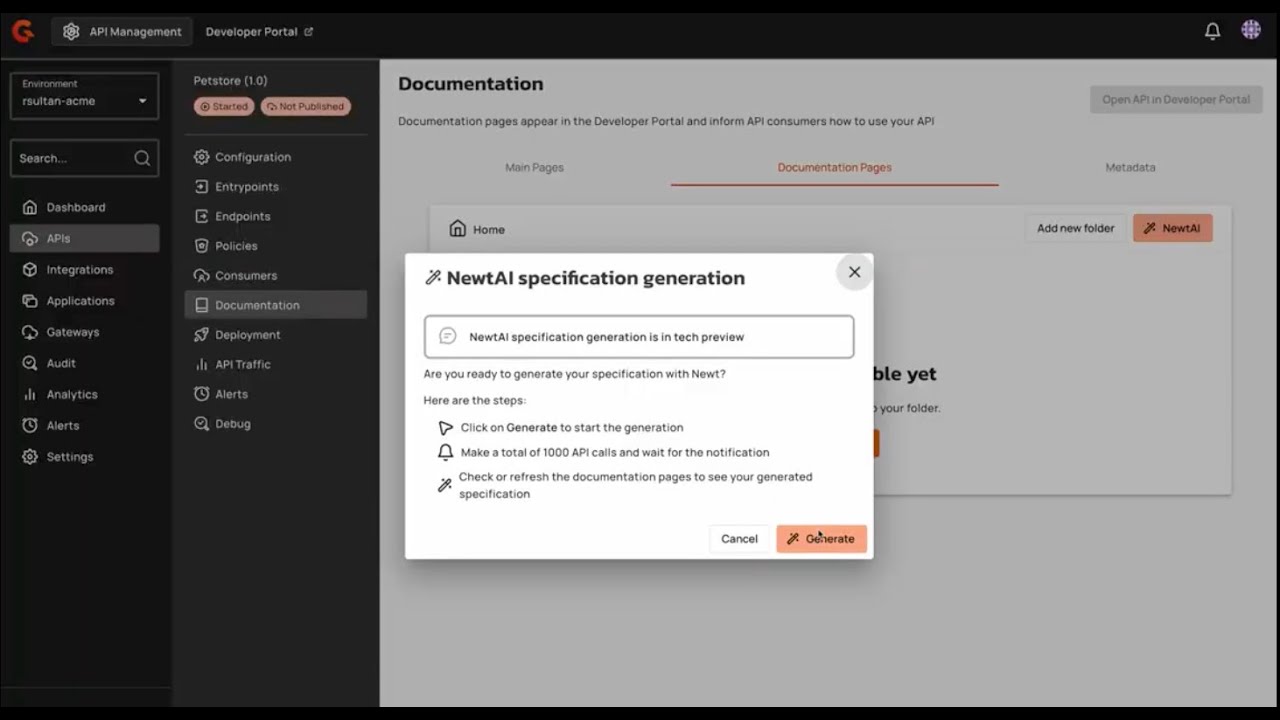
By leveraging Kestra, they’ve managed to integrate orchestration and generative AI into their processes, offering a clever solution for a common yet challenging problem: documentation. Gravitee has introduced a way for its customers to generate API documentation, simplifying the process down to the clarity of a single button.
API documentation is a must-have. Without clear and accurate documentation, APIs become less accessible, limiting their adoption and usability. For Gravitee, the challenge was to automate the creation of documentation to keep pace with the rapid iteration of API creation of their customer. They needed a solution that could:
Gravitee.io chose Kestra to power their documentation workflows. Kestra’s API-first architecture and extensive plugin ecosystem enabled integration with their existing stack, including SQL databases, Docker containers, and Python scripts. Generative AI capabilities added the final touch, allowing them to create developer-friendly documentation on demand.
“Kestra offered a modern stack and an amazing developer experience. It felt built for teams like ours.” — Gravitee.io Engineering Team
Gravitee.io’s workflow showcases the power of combining orchestration with generative AI. Here’s how they use Kestra:
Documentation at the Press of a Button
With Kestra handling the backend orchestration, customers only need to trigger a workflow with a single click. This initiates the generation of developer-friendly, up-to-date documentation for any newly created API.
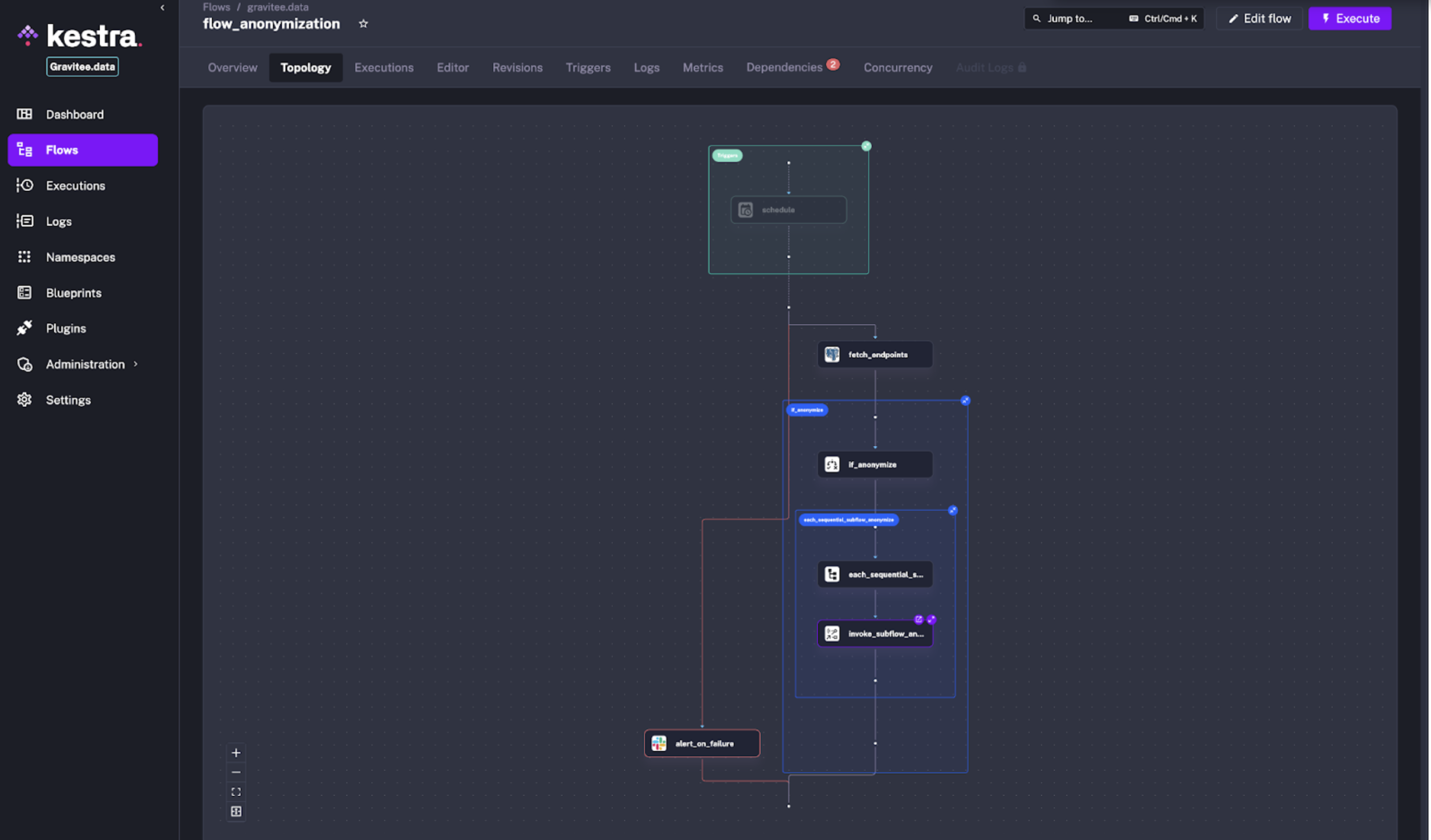
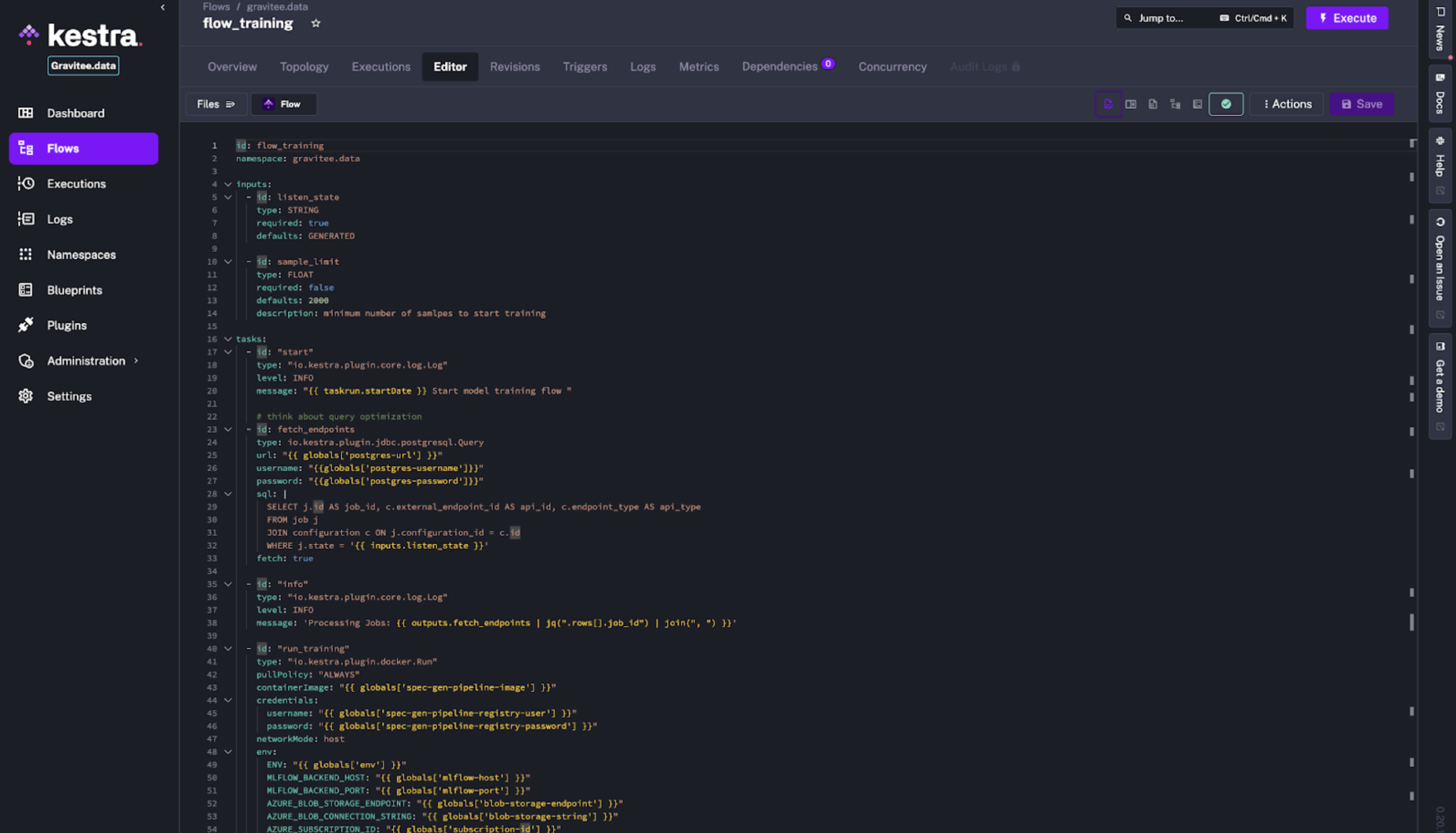
Kestra begins by polling their SQL database to identify API updates or new specifications. This ensures that documentation stays in sync with the latest changes.
Once triggered, Kestra orchestrates a series of Python scripts running in Docker containers. These scripts preprocess API specifications, cleaning and structuring the data to ensure compatibility with their AI models.
Using Kestra’s http.Request tasks, the API specifications are fed into a large language model (LLM). The LLM analyzes the specs and generates comprehensive, developer-friendly API documentation on demand.
To maintain reliability, Kestra monitors the entire workflow. Any errors are immediately flagged, and Slack alerts are sent to the team.
With generative AI accelerating the process, documentation is produced faster than ever, reducing manual effort and saving developers time. Kestra’s modular design ensured the system could grow alongside their expanding API ecosystem, adding new workflows with ease. By automating repetitive tasks, developers are free to focus on building better APIs rather than managing documentation.
Gravitee.io’s experience reflects a broader shift in API management toward automation and intelligent tooling. Static documentation processes can’t match the speed of modern development cycles, making orchestration and AI essential for dynamic API ecosystems. Generative AI offers new capabilities, from transforming technical specs into clear documentation to enabling multilingual guides. Orchestration platforms like Kestra bridge the gap, ensuring these integrations are scalable and reliable.
Their success offers insights for teams facing similar challenges. Automating repetitive tasks, such as documentation, allows developers to focus on more impactful work. Integrating modular tools, like those within Kestra’s plugin ecosystem, helps teams build complex workflows without custom development. Additionally, prioritizing user-friendly solutions made implementation efficient, as Gravitee achieved results with just two developers within six months.
By blending orchestration with generative AI, Gravitee resolved a key developer pain point, empowering users to focus on building APIs rather than managing documentation. Their journey showcases how automation, thoughtful tooling, and developer-first design can transform API management for the future.
But it doesn’t stop there. Gravitee’s experience with Kestra goes well beyond documentation. They’ve adopted Kestra to orchestrate the full lifecycle of their SpecGen system, which uses machine learning and generative AI to generate OpenAPI specs and augment them with clear, human-readable summaries. This includes champion/challenger model comparisons, real-world usage validation, and resilient automation strategies.
“Kestra addressed all of these pain points effectively. It’s great to go with solutions that open-source their code—it builds confidence. Kestra is super easy to use, works with any code, and comes with tons of ready-made connectors.”
By choosing Kestra, Gravitee gained:
If you’re exploring orchestration solutions for AI, data workflows, or API tooling:
Gravitee’s integration of Kestra is live, real-world, and developer-friendly. Check out Gravitee.io to see how they’re rethinking API management with automation and AI at the core.
Have a similar challenge? Reach out via Slack or open a GitHub issue.
If you like the project, give us a GitHub star and join the community.

Stay up to date with the latest features and changes to Kestra