Authors

Ludovic Dehon
CTO & Co-founder
Ludovic Dehon
CTO & Co-founder
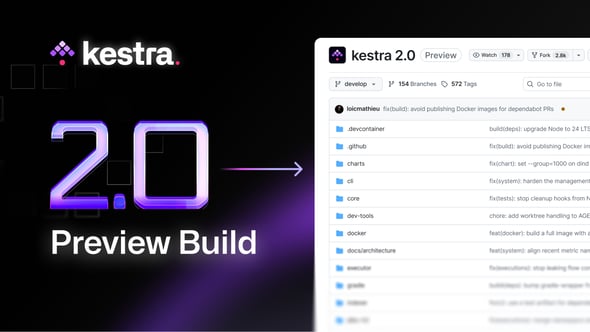
Kestra 2.0 marks the biggest update in the project’s history with a complete overhaul of the execution engine, a redesigned UI, and the most substantial set of changes we’ve ever released. Importantly, Kestra 2.0 remains open source under the Apache 2.0 license, the same as from the start. Unlike many projects that use major versions to change licenses, we are leveraging ours to open up earlier.
Here is a glimpse of what the release will change for you:
Will walks through all of it in the video below if you want to see it running rather than read about it.
Every release candidate undergoes our QA across the full deployment matrix, and we run 2.0 in production on our own infrastructure, orchestrating our own workloads. Release candidates ship roughly every two weeks. You can pull the latest Docker image and run it today.
What we cannot reproduce in any test lab is your stack. Your flows, plugins, deployment, and edge cases. That is the part only you can bring, and it is exactly the feedback that shapes what GA looks like.
Found something? Open an issue on the public repo. Kestra 2.0 issues go where yours go, and the community can see what we are fixing and why. If you want to go further, the door to contributions is open too. Docs, plugins, bug fixes: there is plenty of surface to help with.
The Early Adopter Program is designed for teams that want to put a release candidate through real-world workloads before GA and to influence what ships.
What you get:
More than 40 teams have already joined, running the current release candidate against production-shaped workloads. Their feedback has already changed what ships at GA, from migration docs tested by the program itself to fixes landing in RC after RC. The 2.0 that reaches everyone else will be partly their release. It can be partly yours.
And if you would rather watch before you jump in, we are hosting a series of pre-launch sessions in the coming weeks covering governance, scale, AI, and deployment.
Your existing flows continue to work. A few advanced constructs, such as ForEach and trigger conditions, will require a guided migration.
We would rather tell you now than surprise you later, so we built the tooling first. The flow migration CLI is already public: point it at your flow YAML to get a per-flow diff of what 2.0 changes, and preview everything with a dry run before touching anything. The full migration guide documents every change with before-and-after examples.
Kestra exists because engineers adopted it, contributed to it, and trusted that the open-source core would remain open. A major version is exactly the moment when that trust is tested, and exactly the moment when we get to prove it holds.
Kestra 2.0 is almost here. Download the latest release candidate, or pull the same build from Docker Hub. Then join the Early Adopter Program, or tell us what you found on Slack.
The engine is rebuilt. Help shape the future of orchestration.
Update, September 8, 2026: Kestra 2.0 is generally available. The engineering deep dives are out: what changed in the engine, the 1.3 against 2.0 benchmarks, how to choose your backend, any flow as a tool your agents can call, and plugin performance improvements.

Stay up to date with the latest features and changes to Kestra