Authors

Faizan Qazi
Senior Solutions Engineer
Faizan Qazi
Senior Solutions Engineer
I spent nearly three years at VMware as an Automation Consultant, building custom vRA and vRO automation for banks, government agencies and large companies. Even a single VM provisioning request could involve three consoles: the catalog item in Service Broker, the blueprint in Assembler, and the custom logic in Orchestrator.
Now at Kestra, I talk with teams that want to leave vRA, often because of licensing changes, but don’t know how much work the migration would involve. Many inherited automation built over several years, sometimes by professional services, and the people maintaining it don’t always know what every workflow does. That makes it hard to estimate the migration or confidently approve a plan.
That’s why we built the Kestra Migration Assistant for vRA. Kestra is an open-source orchestrator that infrastructure teams at Crédit Agricole and Dataport run in production. The Migration Assistant’s open-source assessment runs locally against your vRA and vRO exports, inventories the automation, and recommends what to retire, merge, wrap, convert or rebuild. Your engineers review the plan, and we help you migrate the remaining work in waves while vRA keeps running.
The Migration Assistant takes your exported vRO packages and vRA content and produces a migration brief:
These are recommendations for your engineers to review. The result is a plan your team can inspect, correct and sign off on before committing to the migration.
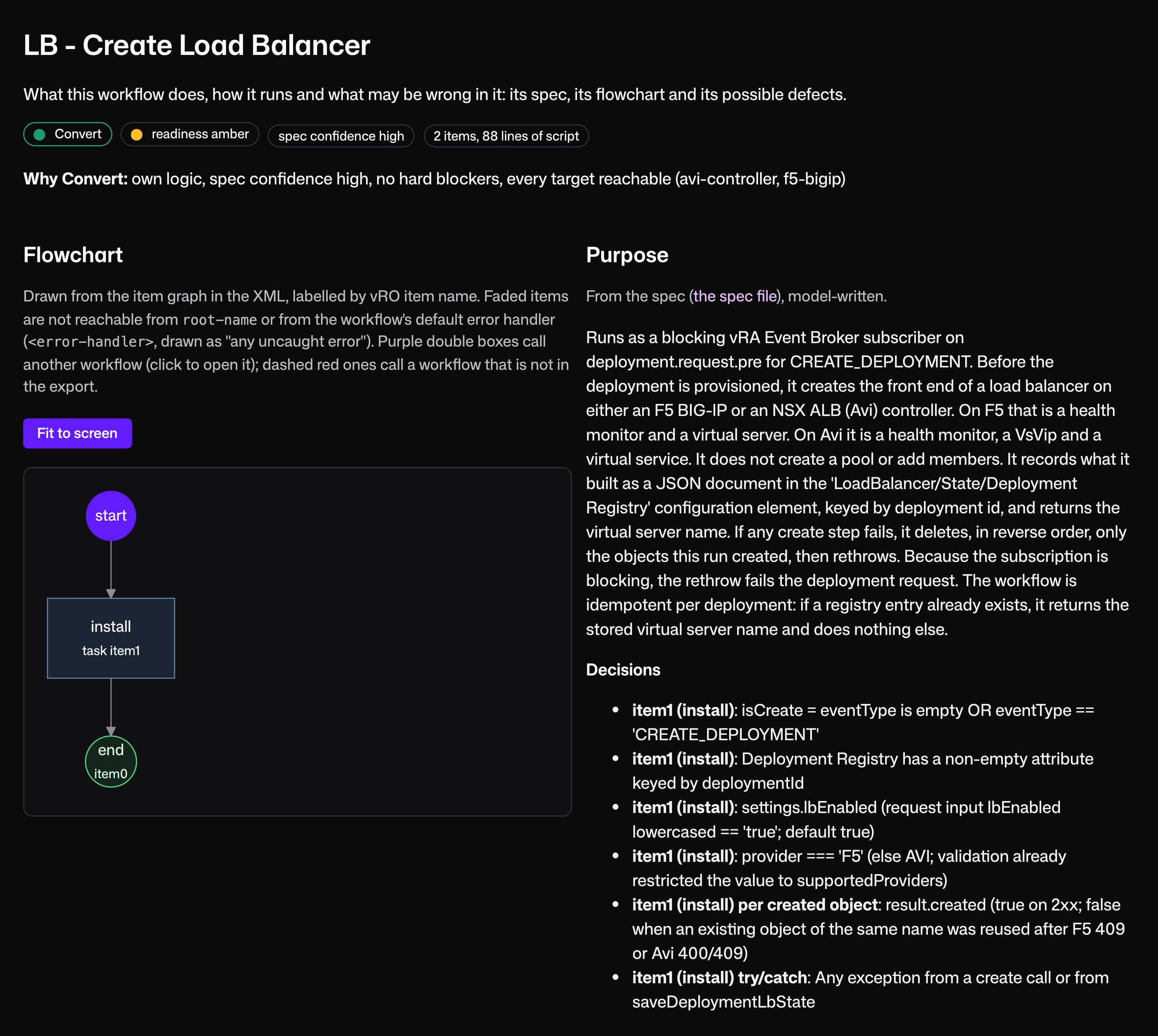 From the brief for the sample load balancer use case, a vRA catalog item and four vRO workflows you can download and assess yourself.
If you estimate the migration by multiplying your workflow count by the effort to convert each one, the result can look overwhelming. Much of that count doesn’t need a rewrite:
Unused workflows are a separate check, because an export shows what exists, not what still runs. In our experience, 10 to 20 percent of workflows in a large environment haven’t run in twelve months. Check execution history in vRO and have each workflow’s owner confirm what’s no longer needed before you drop it.
What’s left is the custom JavaScript and integrations that need real conversion or redesign. Section 3.2 of the vRA migration guide covers the inventory and rationalization process in more detail.
Retries are a good example of code we used to write repeatedly in vRO integration libraries. If a load balancer API call failed, we needed to handle the error, wait and retry with an increasing delay.
In a vRO scriptable task, that could look like this:
var delay = 10000;for (var attempt = 1; attempt <= 3; attempt++) { try { var req = lbHost.createRequest("POST", "/pools/" + poolId + "/members", JSON.stringify({ address: vmIp, port: 443 })); req.contentType = "application/json"; var resp = req.execute(); if (resp.statusCode >= 200 && resp.statusCode < 300) break; throw "Load balancer returned " + resp.statusCode; } catch (e) { if (attempt == 3) throw e; System.warn("Attempt " + attempt + " failed, retrying: " + e); System.sleep(delay); delay = delay * 2; }}In Kestra, the HTTP request and exponential backoff are configured on the task:
- id: add_pool_member type: io.kestra.plugin.core.http.Request uri: "{{ secret('LB_URL') }}/pools/{{ inputs.pool_id }}/members" method: POST contentType: application/json body: '{"address": "{{ inputs.vm_ip }}", "port": 443}' retry: type: exponential interval: PT10S maxInterval: PT1M maxAttempts: 3You still need to decide whether a call is safe to repeat, since a retried POST can add the member twice if the API isn’t idempotent. The retry mechanism itself no longer needs custom JavaScript.
Leaving vRA doesn’t mean replacing the systems it orchestrates. vSphere, Terraform, Ansible, ServiceNow, your CMDB, IPAM, DNS and your secrets manager all stay, with Kestra calling them.
Two decisions affect the migration scope: where users request infrastructure, and where the record of what was provisioned lives. Most of our customers keep both in their ITSM platform, with Kestra handling orchestration behind it. Others move the catalog or resource inventory into Kestra. Make those decisions before converting workflows, because they determine which parts of the environment change. The capability map shows how each part of vRA and vRO maps to Kestra.
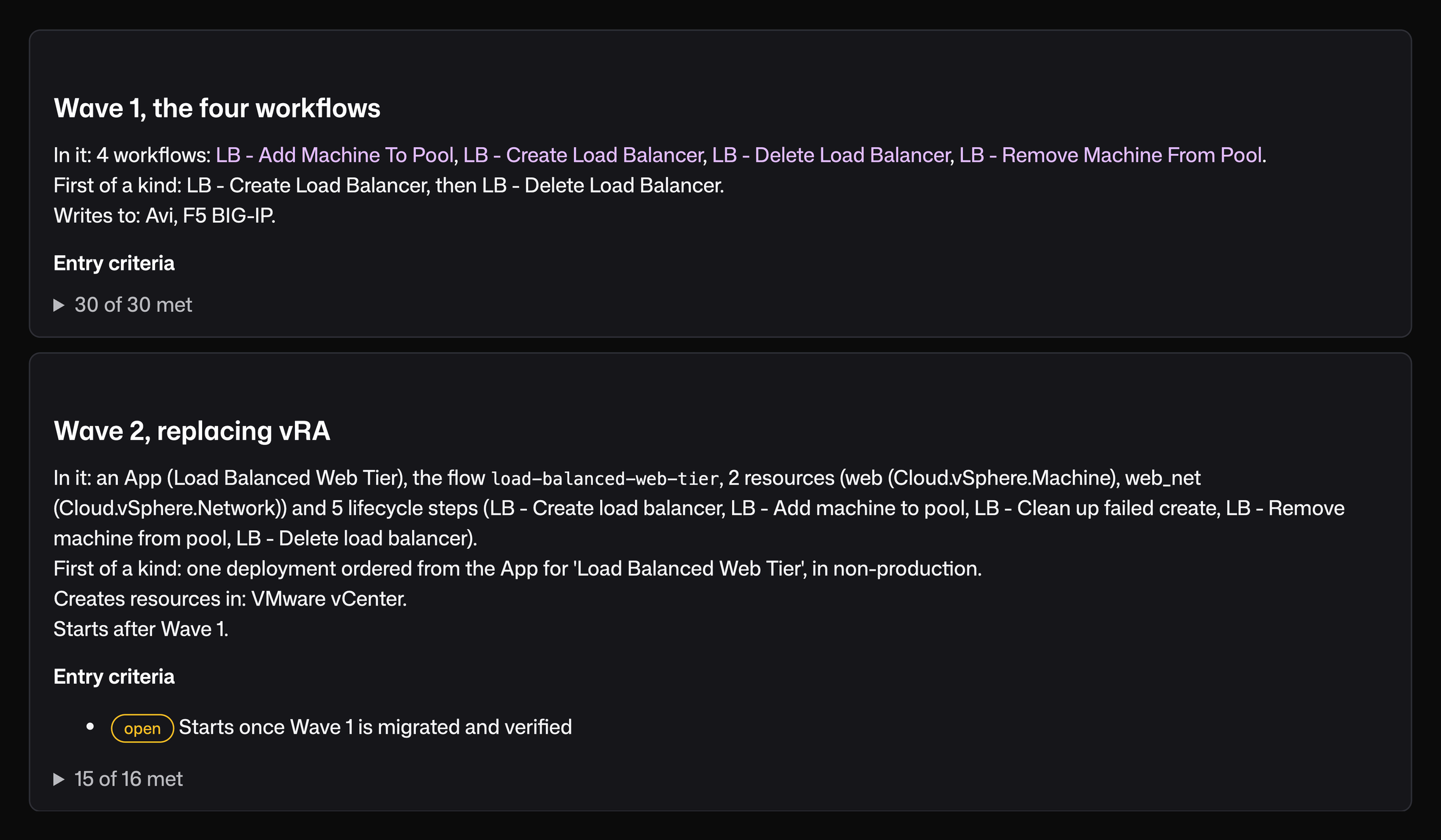 The two waves the brief proposes for the same sample load balancer use case.
Once your team has reviewed the brief, we work with your engineers on the conversion and verification, which are separate from the open-source assessment. vRA and Kestra run side by side for the whole migration, and each workflow runs on one platform at a time. When the first wave is done, Kestra runs those workflows while vRA keeps running the ones still waiting for later waves.
Some workflows are better rebuilt than converted, especially when the logic is poorly understood or would be designed differently today. One public-sector agency with roughly 1,600 vRO workflows chose to reimplement them on Kestra rather than convert the existing code.
The licence is what starts most of these conversations, but the bigger reason to move is who controls your automation. Your infrastructure vendor should not own your automation. VMware can stay as your hypervisor. The automation on top of it should keep working when the hypervisor, the cloud or the contract changes, and it should be able to take on new capabilities, like AI agents or integrations outside the VMware stack, without waiting for your infrastructure vendor’s roadmap. Here’s what Kestra gives you on that front:
The business case still has to work for your environment. The payback calculator compares staying and moving with your own numbers, and the proof of concept replaces its assumptions with rates measured on your own workflows. If you’re keeping VMware Cloud Foundation, confirm that removing vRA actually lowers your licensing bill.
For one customer’s result, a Fortune 500 manufacturer that replaced vRA and vRO with Kestra reports licensing costs 90 percent lower than Aria Automation, and automation services that used to take six months to deliver now take six days.
The vRA migration guide covers the full process, from assessing your environment and deciding what stays, through the proof of concept and payback calculation, to switching vRA off.
→ Read the vRA migration guide
To run the open-source assessment on your own export, or see a sample migration brief first:
→ Get the Kestra Migration Assistant for vRA
You can also see the Migration Assistant in action, starting from the sample vRO and vRA export (free to download) and its migration brief, through to a converted flow tested in the VMware Migration Lab. I’m hosting the European session, and my colleague Parham Parvizi is hosting the Americas session, both with live Q&A:
→ Register: EU session · US session

Stay up to date with the latest features and changes to Kestra