Authors

François Delbrayelle
Lead Software Engineer
François Delbrayelle
Lead Software Engineer
The LLM call is the easy part. By the time a model returns something useful, other tasks have already parsed the source documents, cleaned and chunked the text, generated embeddings, indexed them into a vector store, and pulled back the right context, all of it on a schedule or a trigger, surviving the rate limits and flaky responses that come with hitting model APIs at volume. That surrounding machinery is where an AI pipeline actually lives, and where an orchestrator earns its place.
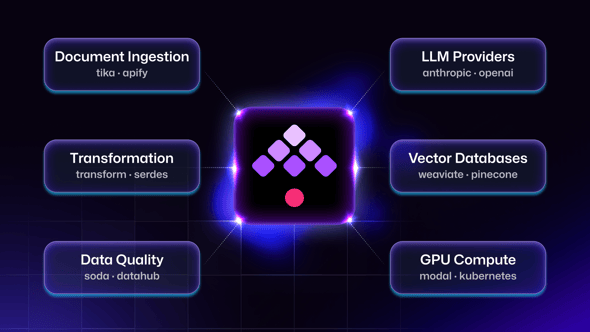
Kestra covers every layer of it. One group, plugin-ai, is purpose-built for the job, with the shared abstractions behind Kestra’s native AI tasks. I’ll map the rest (the plugins you reach for around the model), organized by the role each plays: retrieval, ingestion, serialization, transformation, custom code, GPU compute, data quality, and the cloud and connector plumbing in between.
All AI-related plugins are tagged with the AI category on the Plugins page. Use the category filter to browse them at a glance without scrolling through the full catalog.
Start with the model, since it’s the part everyone pictures first. Kestra ships a dedicated plugin for every major provider, each exposing that provider’s API as a declarative task.
| Plugin | Key tasks | What you get |
|---|---|---|
plugin-anthropic | Chat, Vision | Claude API (text and vision) |
plugin-openai | ChatCompletion, Embedding, ImageEdit, SpeechToText | GPT models, embeddings, DALL·E, Whisper |
plugin-gemini | TextPrompt, Vision | Google Gemini (text and multimodal) |
plugin-mistral | ChatCompletion, Embedding | Mistral AI (chat and embeddings) |
plugin-deepseek | ChatCompletion | DeepSeek reasoning models |
plugin-ollama | ChatCompletion, Embedding | Self-hosted LLMs via Ollama |
plugin-perplexity | ChatCompletion | Perplexity (search-augmented responses) |
plugin-huggingface | Inference | 700k+ HuggingFace models via Inference API |
The wrapper is the least interesting part; the orchestration around the call is what matters. LLM and embedding endpoints rate-limit hard and fail intermittently, so a retry with exponential backoff turns a 429 into a non-event rather than a broken run. Credentials resolve from {{ secret('OPENAI_API_KEY') }} at runtime instead of living in the flow source (see Secrets in Kestra). And because the provider is a single type: line, swapping GPT for Claude (or fanning out to several models in parallel) is a config change, not a rewrite.
A model is only as good as the context you retrieve for it, which puts the vector store at the center of most RAG systems. Kestra spans the full spectrum of them, from purpose-built vector databases to search engines that have grown vector extensions.
plugin-weaviate is the most AI-native of the set: SchemaCreate defines collection structure, BatchCreate handles bulk vector ingestion, Query runs GraphQL-based semantic and hybrid search, and Delete cleans up. Its nearText and nearVector operators map directly onto RAG retrieval, so the task config reads the way you reason about the query.
plugin-pinecone covers Pinecone’s fully managed serverless store: index and namespace management, vector upsert and delete, and similarity queries with metadata filtering. No infrastructure to run.
If you already run a search cluster, you may not need a separate vector database. These add vector search alongside the keyword search you already have, which is why hybrid BM25 + k-NN retrieval is so often the pragmatic default.
| Plugin | Notable tasks | Vector capability |
|---|---|---|
plugin-opensearch | Search, Bulk, Load, Scroll, Ppl | k-NN vector search + BM25 hybrid |
plugin-elasticsearch | Search, Bulk, Load, Scroll | Dense vector fields + BM25 hybrid |
plugin-typesense | Search, BulkIndex, FacetSearch | Fast typo-tolerant + vector search |
plugin-meilisearch | Search, DocumentAdd, FacetSearch | Lightweight open-source semantic search |
plugin-mongodb exposes Find with $vectorSearch (Atlas Vector Search), Aggregate for multi-stage pipelines, and Bulk for large ingestion batches. Its Trigger fires on Change Streams, so a new or updated document can kick off re-indexing in near real time instead of waiting for the next batch run.
plugin-redis handles JSON document storage (Get, Set, Delete) and Pub/Sub (Publish). With RedisSearch enabled it doubles as a high-throughput embedding cache and real-time retrieval layer.
plugin-neo4j provides Query (Cypher, with configurable result handling) and Batch for bulk operations. Knowledge graphs let an LLM traverse explicit relationships for reasoning chains and entity resolution, a pattern that shows up more and more in agentic architectures.
RAG starts with raw content, and embeddings can’t be generated until that content is clean text.
plugin-tika wraps Apache Tika. Its Parse task pulls text, metadata, and embedded files out of PDFs, Word documents, PowerPoint files, Excel spreadsheets, HTML, images (with optional OCR via Tesseract), and dozens of other formats. One task handles the full range of enterprise document types, the standard first step in an ingestion flow and an obvious place to fan out across workers at volume.
plugin-apify covers the web. Run launches an Apify actor with configurable inputs and run caps, Get and GetLastRun retrieve the resulting dataset, and Save persists it to Kestra’s internal storage for downstream tasks. It’s the practical path for feeding live web content into a retrieval or training pipeline.
Data rarely arrives in the shape the next task wants. plugin-serdes converts the formats that show up throughout AI workflows (CSV, JSON, AVRO, Parquet, XML, YAML, Protobuf, Excel) to and from Kestra’s internal Ion format, so any two tasks can exchange data without bespoke parsing.
Three of its capabilities matter especially for AI work.
Markdown conversion. HtmlToMarkdown turns verbose HTML into Markdown that carries the same structure in far fewer tokens, directly useful for RAG and LLM preprocessing. MarkdownToText strips formatting to clean plain text for embedding models that don’t need markup; MarkdownToHtml covers the return trip for email templates or rich notifications.
TOON. JsonToToon and ToonToJson convert between JSON and TOON (Token-Oriented Object Notation), a deterministic, indentation-based format with explicit structure and minimal quoting. For uniform arrays of objects it uses a tabular encoding that conveys the same data in far fewer tokens than JSON, lowering cost and latency on every inference call that passes structured context.
Schema inference. InferAvroSchemaFromIon scans an Ion file and emits a matching .avsc schema, removing the hand-written schema step before a conversion to Avro or Parquet.
Models are sensitive to input quality, and most of what determines that quality happens before the embedding call. Kestra offers transformation layers from lightweight expression-based transforms up to full SQL modeling.
plugin-transform operates on Kestra’s internal record streams. The Records module covers Filter (boolean expressions), Map (field projection, and the natural place to chunk text before embedding), Select (renaming), Aggregate (grouping with sum/count/avg), Unnest (flattening nested arrays), and Zip (merging streams by index). The Grok module parses unstructured text with named patterns, and the JSONata module reshapes JSON, handy for normalizing an LLM’s output before anything downstream consumes it.
plugin-datagen generates synthetic data with Faker-based generators. Generate produces configurable batches as JSON, CSV, or SQL, and a RealtimeTrigger drives continuous generation for streaming pipelines. The main AI use is reproducible training and evaluation datasets that never touch production data.
plugin-dbt brings SQL feature engineering into the flow. Run dbt models, execute tests, and install dependencies as discrete tasks, so feature pipelines stay version-controlled, testable, and observable alongside everything else.
When nothing pre-built fits, Kestra runs arbitrary code across 18 language runtimes.
plugin-scripts runs Script and Commands tasks for Python, Node.js, R, Julia, Go, Ruby, Shell, Perl, PHP, Lua, Deno, Bun, JBang, Groovy, Jython, Nashorn, and more. The Python task supports pip and UV, so installing transformers, torch, or any other library is a line of config and the environment is reproducible. This is the escape hatch for custom inference logic, fine-tuning jobs, or integrations no dedicated plugin covers.
plugin-graalvm runs Python, JavaScript, and Ruby in-process via GraalVM, with no container to start. Eval runs inline scripts and FileTransform applies a script to a file. The tradeoff is that GraalVM’s Python compatibility is narrower than CPython’s, so it suits lightweight transforms and preprocessing rather than heavy ML workloads.
Heavy inference and fine-tuning need a compute backend beyond a standard Kestra worker.
plugin-modal wraps the Modal CLI: ModalCLI runs Modal functions on serverless GPU infrastructure, which fits fine-tuning, batch inference, or any compute-heavy job you’d rather not provision GPU instances for.
plugin-docker and plugin-kubernetes handle container execution. Docker tasks run ML containers locally or on a Docker host; Kubernetes tasks (Deploy, Job) schedule GPU workloads on a cluster. Paired with Kestra’s task runners, they make GPU job submission fully declarative.
plugin-databricks connects Kestra to Databricks for notebook execution, job submission, and MLflow integration, the standard path for teams already on that platform.
Garbage in, garbage out is unforgiving for training and evaluation data, so reliable pipelines validate before they trust.
plugin-soda runs Soda scans against any source: null rates, value distributions, schema drift, referential integrity. Kestra surfaces the results as task outputs, which means you can gate downstream tasks on a scan and stop a bad dataset before it ever reaches a model.
plugin-datahub emits lineage events to DataHub, making model inputs, intermediate datasets, and outputs traceable in the catalog.
Each major cloud exposes an AI-relevant surface area through its Kestra plugin.
| Plugin | AI-relevant services |
|---|---|
plugin-aws | S3 (data lake), Bedrock (managed LLMs), SageMaker (training/inference), Textract (OCR), Comprehend (NLP) |
plugin-gcp | Vertex AI (training/serving), BigQuery ML, Cloud Storage, Document AI |
plugin-azure | Azure OpenAI, Cognitive Services, Blob Storage, Azure ML |
Beyond compute and storage, pipelines need reliable transport and versioning.
plugin-kafka drives event-based architectures: consume a stream of user interactions for real-time RAG, or publish inference results downstream. A Kafka trigger fires a flow on each message or batch, which is the standard pattern for keeping a vector index continuously up to date.
plugin-git and plugin-github bring prompts and configuration under version control. Store prompts, system instructions, and model settings as code, then pull them at runtime so every run executes against a pinned, auditable version.
plugin-fs provides filesystem and object-storage tasks for S3, GCS, SFTP, FTP, and local paths, moving model inputs and outputs between stages.
A typical RAG pipeline draws on four to six of these groups in sequence:
plugin-tika parses source documents; plugin-apify scrapes web contentplugin-transform cleans and chunks the text; plugin-serdes converts formatsplugin-openai or plugin-huggingface generates the vectorsplugin-weaviate, plugin-pinecone, or plugin-opensearch stores themplugin-anthropic or plugin-gemini answers using the retrieved contextplugin-soda checks quality at each stage; plugin-datahub records lineageEvery step is a task, and data moves between them through Kestra’s internal storage, so each stage hands off cleanly to the next. The flow YAML is the single source of truth: version-controlled, observable end to end, and portable anywhere Kestra runs. Re-indexing the corpus from scratch is a backfill; keeping it current is a trigger. The model was never the hard part. Making everything around it dependable is, and that’s the part Kestra owns.
For a deeper look at how these pieces fit together in production, see RAG workflows in Kestra.
Kestra ships dedicated plugins for Anthropic, OpenAI, Gemini, Mistral, DeepSeek, Ollama, Perplexity, and HuggingFace. Each wraps the provider’s API as declarative Kestra tasks with native retry, secret, and observability support.
plugin-weaviate and plugin-pinecone are purpose-built for vector storage and retrieval. plugin-opensearch and plugin-elasticsearch provide hybrid BM25 + k-NN search. plugin-typesense and plugin-meilisearch offer lightweight alternatives. plugin-mongodb supports Atlas Vector Search. plugin-redis covers embedding caching. plugin-neo4j handles knowledge graph retrieval.
plugin-scripts runs Python Script and Commands tasks with pip or UV dependency management; install any ML library inline. For lightweight transforms without container overhead, plugin-graalvm runs Python, JavaScript, and Ruby in-process via GraalVM.
plugin-tika (Parse task) handles PDFs, Office formats, HTML, images (with OCR), and dozens more: one task covers the full enterprise document corpus. For web content, plugin-apify adds web scraping via Apify actors.
Yes. plugin-modal submits serverless GPU jobs to Modal. plugin-kubernetes schedules GPU workloads on Kubernetes. plugin-docker runs GPU-enabled containers locally or on a Docker host.
If you like the project, give us a GitHub star ⭐️ and join the community.

Stay up to date with the latest features and changes to Kestra