Authors

Elliot Gunn
Product Marketing Manager
Elliot Gunn
Product Marketing Manager
Airflow 3 brings real improvements, but the migration effort is substantial enough that teams should evaluate whether Airflow still fits their needs before committing engineering cycles to the upgrade.
In a previous post, we looked at Airflow alternatives for teams considering a move away from Python-first orchestration. But what if you’re not sure whether to leave Airflow at all? What if you just want to understand whether the Airflow 3 upgrade is worth the engineering effort?
Airflow 2.x entered limited support mode in April 2026. That means security patches only, no bug fixes, no new features. If you’re still on Airflow 2, the decision is now unavoidable: invest in migrating to Airflow 3, or use this forced refactor as an opportunity to reconsider your orchestration strategy entirely.
The answer depends on what you’re optimizing for, and whether Airflow 3 fixes the specific pain points your team is experiencing. Let’s break it down.
Airflow 3, released in April 2025, represents a fundamental architectural shift. The changes are deep enough that many teams are discovering their “upgrade” is actually a rewrite project.
Airflow 3 introduces a modern React-based UI that replaces the dated Flask interface. The new Task SDK provides cleaner abstractions for defining workflows. DAG versioning finally lets you track changes over time. The REST API has been rebuilt with FastAPI, making it faster and more capable.
Data-aware scheduling with Assets (the rebranded Datasets feature) makes it easier to trigger workflows based on data availability rather than just cron schedules. Human-in-the-Loop functionality allows workflows to pause for manual approval, useful for ML pipelines and content moderation workflows.
These are genuine improvements, but the migration cost is where things get complicated.
Let’s acknowledge what the upgrade gets you:
Modern interface. The new React UI is significantly more responsive and intuitive than the old Flask-AppBuilder version. It feels like a product built in 2025, not 2015.
Better developer experience. The Task SDK simplifies how you define tasks. Less boilerplate, clearer patterns, easier to onboard new team members.
Improved API performance. The FastAPI-based REST API is noticeably faster, especially for teams that integrate Airflow with other systems programmatically.
DAG versioning. You can now track workflow changes over time without building your own versioning system on top of Git.
Data-aware orchestration. Assets make it easier to model dependencies based on actual data availability, not just guessing when upstream tasks finish.
If your team is Python-native, deeply invested in the Airflow ecosystem, and not hitting any major architectural limitations, these improvements are probably worth the migration effort.
Here’s where the pain lives. Airflow 3 introduces breaking changes that will require refactoring across your entire DAG library.
Direct database access is gone. In Airflow 2, tasks could query the metadata database directly. Many teams built custom operators and monitoring around this. Airflow 3 removes this entirely. If your code uses database sessions, you’ll need to refactor everything to use the REST API via the official Python client.
Removed features you might rely on:
execution_date, prev_ds, next_ds are removed (your templates will break)Architectural changes that affect deployment:
The webserver is now split into two components: an API server and a separate DAG processor. Your Kubernetes manifests, deployment scripts, and monitoring all need updates. Standard operators (BashOperator, PythonOperator, etc.) now live in a separate apache-airflow-providers-standard package, requiring import updates across your codebase.
The Airflow team provides Ruff linter rules to identify breaking changes automatically (ruff check dags/ --select AIR301,AIR302), but you still need to manually refactor each broken pattern. For large DAG libraries, this is weeks of work, not days.
Practically speaking, the Airflow 3 upgrade makes sense for a narrow subset of teams: those who are Python-native, have significant existing investment, and aren’t hitting architectural walls.
But even teams that fit this profile should pause to consider where their orchestration needs are heading. If you’re building AI agent workflows, for example, a YAML-based declarative DSL often works better than Python code. Many teams are integrating AI capabilities into their data stacks, and the orchestrator you choose today will either enable or constrain that roadmap.
But if you’re hitting friction with Airflow’s persistent limitations, the forced migration is worth pausing on. Here’s what Airflow 3 doesn’t fix:
Still Python-only for workflow definitions. If your team includes dbt analysts, Go developers, or anyone who doesn’t want to learn Python decorators, they still can’t contribute directly. You’ll still be writing wrapper code.
Multi-tenancy is still limited. Enterprise teams with multiple business units sharing an Airflow instance will find the same RBAC and namespace constraints. Governance is better, but not fundamentally different.
Operational complexity arguably increased. The split between API server and DAG processor adds deployment complexity. You now have more components to monitor, scale, and debug.
Batch-first architecture unchanged. If you need event-driven workflows that respond to webhooks, file uploads, or message queues in real-time, Airflow 3’s architecture hasn’t fundamentally changed. You’re still working around a scheduler designed for cron-based batch jobs.
If any of these limitations are causing real pain for your team, you’re going to refactor your workflows anyway. The question becomes: should you refactor toward Airflow 3, or toward something that addresses these gaps directly?
If you’re already facing the task of refactoring for Airflow 3, it’s a good moment to evaluate a different orchestration model, like Kestra.
Kestra is an open-source, event-driven orchestration platform for data, infrastructure, and AI workflows, with workflows defined as code - accessible through a unified interface:
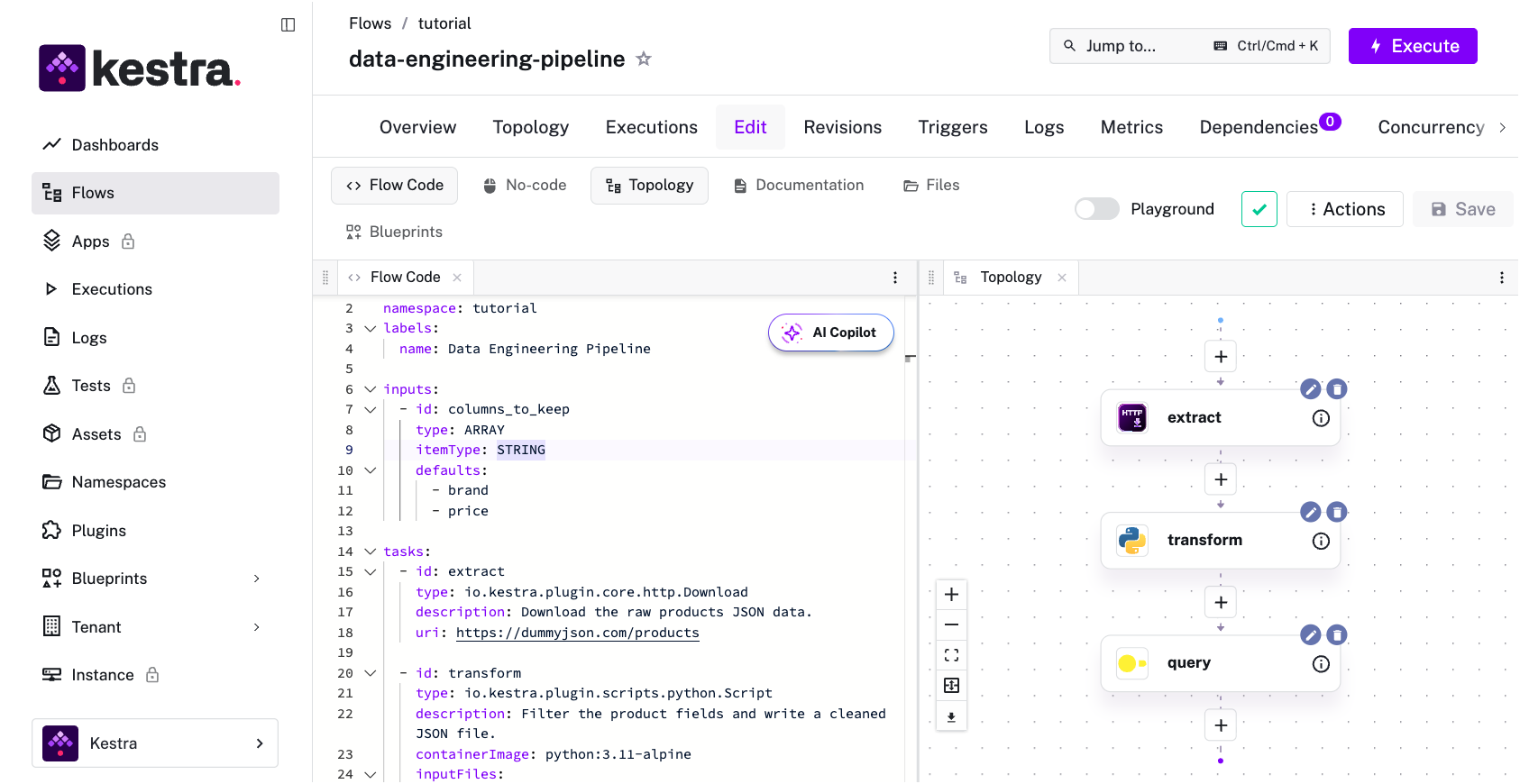
How Kestra is different:
Here’s the practical difference. An Airflow DAG requires Python knowledge even for simple orchestration:
from airflow import DAGfrom airflow.operators.python import PythonOperatorfrom airflow.operators.bash import BashOperatorfrom datetime import datetime
with DAG('daily_etl', start_date=datetime(2024, 1, 1), schedule='@daily') as dag:    extract = PythonOperator(task_id='extract', python_callable=extract_data)    transform = BashOperator(task_id='transform', bash_command='dbt run')    extract >> transform
In Kestra, the same workflow is declarative:
id: daily_etlnamespace: company.team
tasks:  - id: extract    type: io.kestra.plugin.scripts.python.Commands    namespaceFiles:      enabled: true    commands:      - python main.py
  - id: transform    type: io.kestra.plugin.dbt.cli.DbtCLI  # see /plugins/plugin-dbt    commands:      - dbt run
triggers:  - id: daily    type: io.kestra.plugin.core.trigger.Schedule    cron: "0 0 * * *"
The difference isn’t just syntax. Kestra’s architecture addresses the persistent gaps in Airflow 3:
Language-agnostic by design. Orchestrate Python, SQL, dbt, shell scripts, Go, Node.js, whatever your team uses. No wrapper code, no forcing everyone into Python.
Native governance built-in. RBAC, namespace isolation, and audit logging ship out of the box. You don’t need to bolt on enterprise features later.
Event-driven from the start. Trigger workflows from webhooks, file uploads, message queues, or API calls. Not just cron schedules.
Gentler migration path. You can run Kestra alongside Airflow, migrate incrementally, and even trigger Kestra flows from Airflow DAGs during the transition. No big-bang cutover required. Teams like Crédit Agricole used this approach to move from Jenkins and Ansible to Kestra, orchestrating infrastructure across 100+ clusters without downtime.
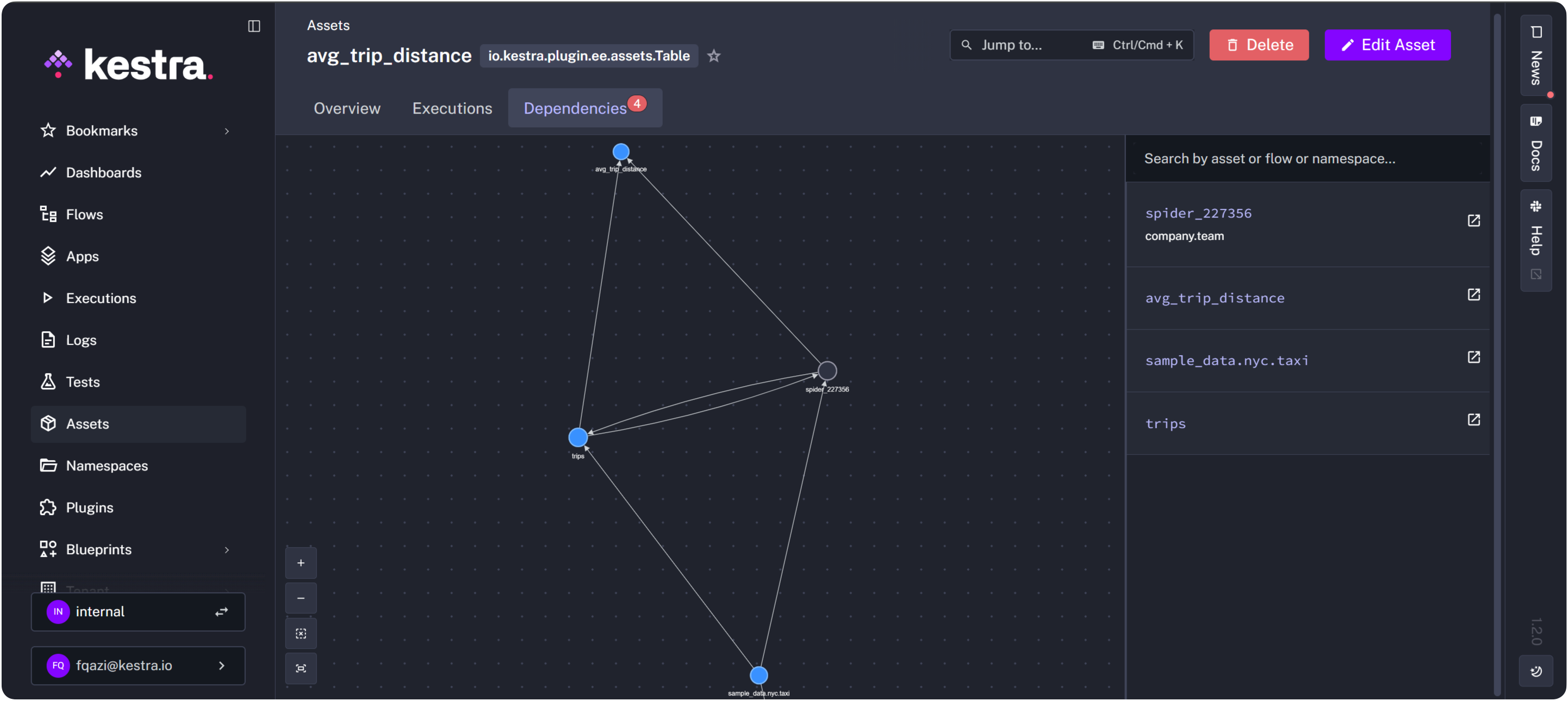
Complete lineage with Assets. Airflow 3 introduces Assets (rebranded from Datasets) for data-aware scheduling, but they only track data dependencies between tables. Kestra’s Assets track both data artifacts (tables, files, datasets) and infrastructure resources (buckets, VMs, compute) in a unified inventory. When your DevOps team moves an S3 bucket or provisions new infrastructure, you can trace which workflows depend on it.
And Kestra builds the lineage graph automatically to show you the dependencies between Asset. Here, the blue represents Asset objects, grey represents the Flows.
Kestra is open-source and can be run locally with Docker in just 5 minutes with our Quickstart Guide.
Here’s a simple framework:
Choose Airflow 3 if:
Reconsider your orchestrator if:
Either path requires planning, testing, and coordination. If you haven’t started yet, the time pressure is now real.
For a broader view of what’s available beyond Airflow, see our guide to enterprise Airflow alternatives.
📘 Get the full migration analysis. Our free Airflow 2 EOL guide covers upgrade paths, breaking changes in detail, and a side-by-side comparison of staying vs. switching. Download the Guide →
If you’re reconsidering your orchestration strategy and want to see how Kestra addresses the gaps we’ve discussed, book a demo with our team. You can also explore Kestra’s declarative orchestration approach and language-agnostic execution as alternatives to Python-only DAGs. We’ll walk through your specific use cases and help you determine if it’s the right fit.

Stay up to date with the latest features and changes to Kestra