Automate Config Drift Detection and Get Slack Alerts
For the complete documentation index, see llms.txt. For a full content snapshot, see llms-full.txt. Append.mdto anykestra.io/docs/*URL for plain Markdown.
Keeps configs consistent and surfaces drift without manual checks with Ansible and Kestra.
Use Ansible to enforce a required environment variable across multiple hosts and have Kestra alert you in Slack when a change occurs.
Files to store as Namespace Files
Ansible expects two file types: an inventory.ini and a playbook.yml. To use with Kestra, they can either be stored as Namespace Files or written in-line in the flow code. The example continues using Namespace Files.
inventory.ini(replace with your hosts and users; keys shown as placeholders):
[servers]server1.example.test ansible_user=admin ansible_ssh_private_key_file=~/.ssh/id_rsaserver2.example.test ansible_user=admin ansible_ssh_private_key_file=~/.ssh/id_rsaserver3.example.test ansible_user=admin ansible_ssh_private_key_file=~/.ssh/id_rsamyplaybook.yml(enforceMY_APP_MODEand refresh the shell):
---- name: Ensure environment variable is set correctly  hosts: servers  become: true
  tasks:    - name: Ensure MY_APP_MODE is set      lineinfile:        path: /home/{{ ansible_user }}/.bashrc        regexp: '^MY_APP_MODE='        line: 'MY_APP_MODE=production'        state: present      notify: Refresh environment
  handlers:    - name: Refresh environment      shell: . /home/{{ ansible_user }}/.bashrc      changed_when: false
Flow: run Ansible and alert on drift
This flow runs the playbook with the Ansible CLI task, inspects each host result in a Loop, and posts a Slack alert only when a host was changed using the Slack Incoming Webhook task. The schedule trigger is disabled by default — enable it to run nightly.
id: ansible_config_driftnamespace: company.team
tasks:  - id: set_up_env    type: io.kestra.plugin.ansible.cli.AnsibleCLI    namespaceFiles:      enabled: true    taskRunner:      type: io.kestra.plugin.core.runner.Process    ansibleConfig: |      [defaults]      interpreter_python = auto_silent      log_path={{ workingDir }}/log      callback_plugins = ./callback_plugins      callbacks_enabled = kestra_logger      stdout_callback = ansible.builtin.null    commands:      - ansible-playbook -i inventory.ini myplaybook.yml
  - id: loop_hosts    type: io.kestra.plugin.core.flow.Loop    values: "{{ outputs.set_up_env.playbooks[0].plays[0].tasks[1].hosts }}"    tasks:      - id: check_drift        type: io.kestra.plugin.slack.notifications.SlackIncomingWebhook        runIf: "{{ fromJson(item.value).result.changed == true }}"        url: "{{ secret('SLACK_WEBHOOK') }}"        payload: |          {              "text": "Configuration updated on {{ fromJson(item.value).host }} - {{ fromJson(item.value).result.msg ?? '' }}"          }
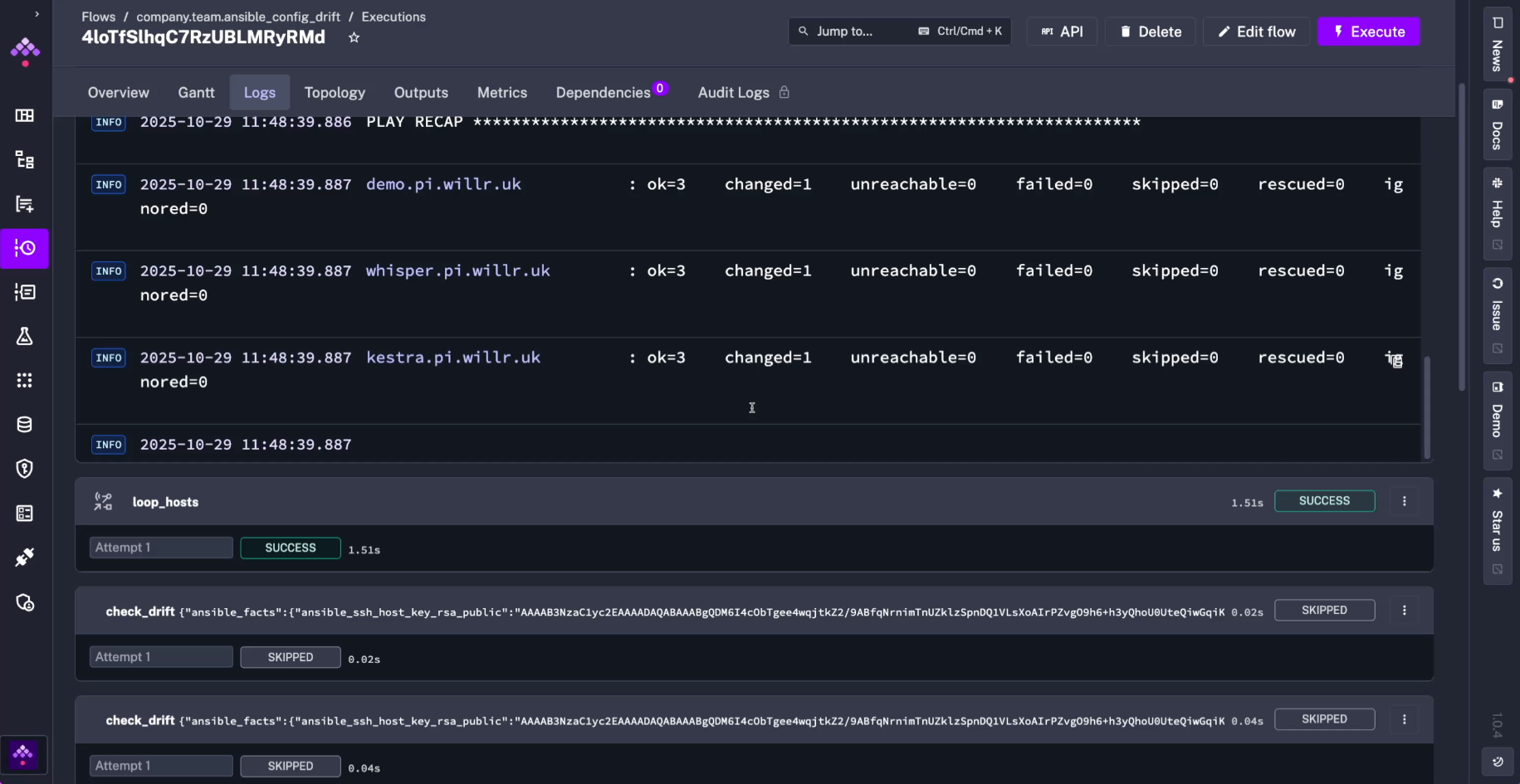
triggers: - id: check_nightly type: io.kestra.plugin.core.trigger.Schedule cron: 0 3 * * * disabled: trueThe execution generates logs for every play in the playbook for clear results and monitoring:
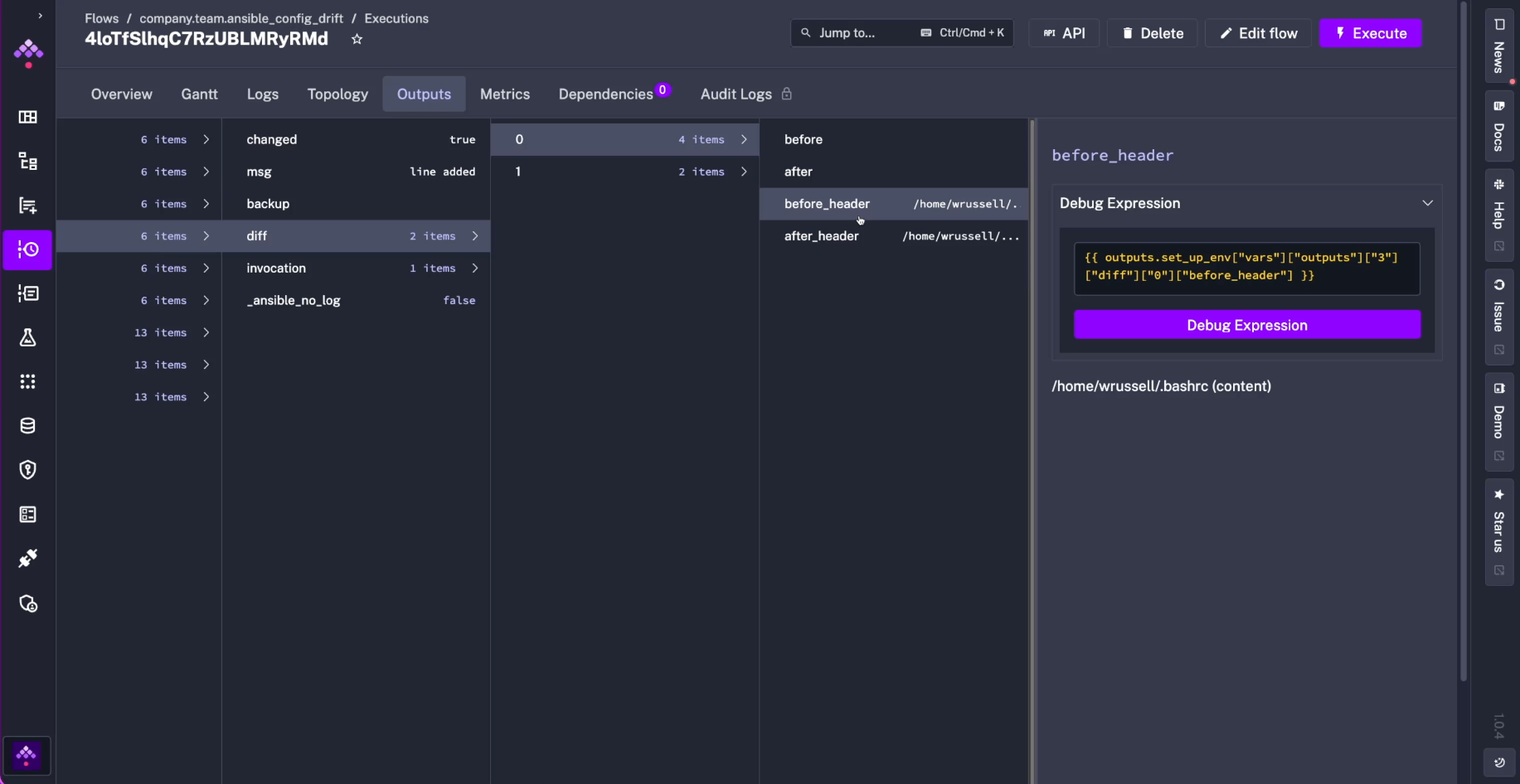
In the execution outputs, you can examine results and debug expressions to use in potential downstream tasks or subflows:
Why this matters
This pattern enforces a critical env var across a fleet to catch drift quickly, streams Ansible output in structured form via the kestra_logger callback, and alerts only on changed hosts to keep Slack noise low. Keeping the playbook and inventory as Namespace Files means you can version and reuse them across flows without hardcoding paths in each run.
You can expand this pattern to check multiple config files, package versions, or CIS controls per host, while letting Kestra handle scheduling, secrets, notifications, and downstream tasks (tickets, S3 archiving, SIEM) so Ansible remediation and orchestration stay tightly linked.
Was this page helpful?